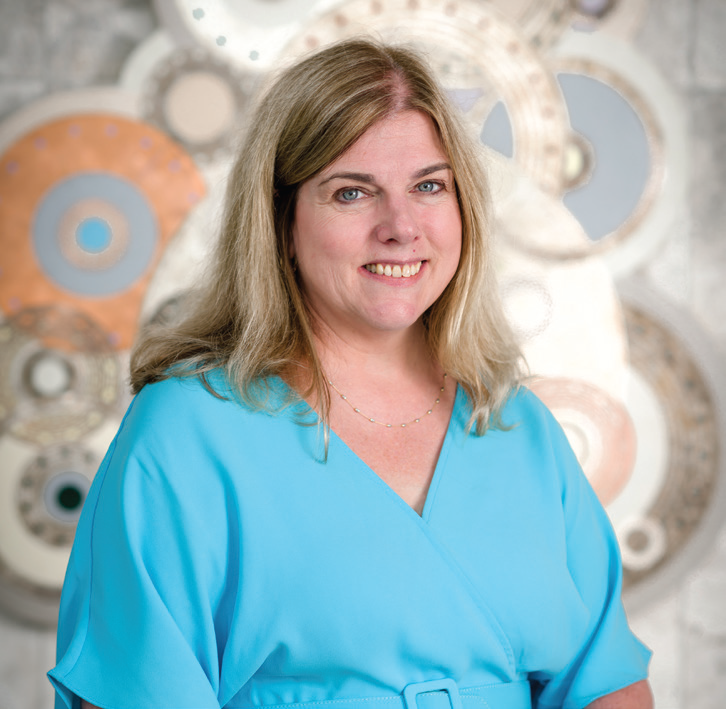
When Kathleen Amm describes how she entered cryogenics, she does not point to a single defining moment. Instead, her path began with movement. In the early 1990s, she followed her thesis advisor Justin Schwartz from the University of Illinois to Tallahassee as the National High Magnetic Field Laboratory was opening. It was a rare convergence of timing and opportunity. A new national facility was coming online and a young researcher was stepping into a field where low temperature science was not a curiosity but a necessity.
As a graduate student, Amm worked on high temperature superconductors at a time when the field was still sorting promise from practicality. Her focus was an especially challenging compound mercury barium calcium copper oxide which required synthesis in high pressure oxygen and mercury environments. The material proved resistant to being formed into useful wire but the work immersed her in the chemistry and physics of superconductivity. Just as importantly, it placed her squarely inside the cryogenic environment. She characterized samples using SQUID magnetometry and torque magnetometry in the Magnet Lab’s high field DC facility and learned the everyday realities of low temperature work. She learned to transfer helium by hand, waiting for the line to cool and watching for the appearance of liquid before committing it to a magnet. Those early experiences shaped her understanding of cryogenics as both a scientific discipline and a practical craft.
Amm’s career soon moved beyond being a user of cryogenic systems to helping design them. Her first professional role took her to Lytle Manning where she worked on cryogenic insulation and blanket development including systems used in MRI magnets. The work drew on technology that originated in large particle physics programs and highlighted a recurring truth in cryogenics: control of heat leaks is as critical as the performance of the cold source itself. Insulation is never a passive component but a central part of system design.
From there, Amm joined the GE Research Center where her work expanded across materials measurement and full-scale cryogenic system development. One early project focused on carbon fiber suspension systems for open MRI magnets. The challenge was to achieve high mechanical strength with minimal thermal conduction. Amm performed detailed thermal conductivity measurements from 4.2 K to room temperature, a process that required days of stabilization for each data point. The work resulted in a best paper award at the Cryogenic Engineering Conference and International Cryogenic Materials Conference and marked her entry into cryogenic engineering as a field of precision patience and system thinking.
Her most influential work at GE centered on the development of low cryogen superconducting MRI magnets using thermosiphon cooling. The goal was ambitious: reduce helium inventory from thousands of liters to roughly ten while maintaining stability, reliability and serviceability. The system was designed to cool slowly, using wall power with the option for faster cooldown through an auxiliary nitrogen system. A critical requirement was that cold head replacement could occur without warming the magnet. Achieving that balance between heat loads, cooldown behavior and ride through time was a complex engineering challenge. Working with colleagues, including Tao Zhang and Wolfgang Stautner, Amm helped deliver a technically successful system that demonstrated a new way of thinking about helium management in MRI.
Although the design was initially judged too costly to produce, it anticipated the industry’s move toward zero boiloff MRI systems. Today, recondensing technology is standard across MRI platforms, and cryogenics has shifted from constant helium refilling to long term closed cycle operation. For Amm, MRI represents one of the clearest examples of cryogenics and superconductivity transforming daily life. From eliminating exploratory surgery to improving cancer treatment planning and advancing studies of neurological disease, MRI has become a foundational medical technology whose impact reaches far beyond the laboratory.
Building on her low cryogen MRI work, Amm led efforts to adapt similar concepts to superconducting wind turbines. The challenge was scaling reliability and performance to systems that could operate unattended at the top of a turbine. Rather than waiting for high temperature superconductors to reach cost targets, the team explored what could be done with existing low temperature technology paired with robust cryogenic design. The project later received support from the US Department of Energy and reflected Amm’s interest in applying cryogenics to energy systems with real-world constraints.
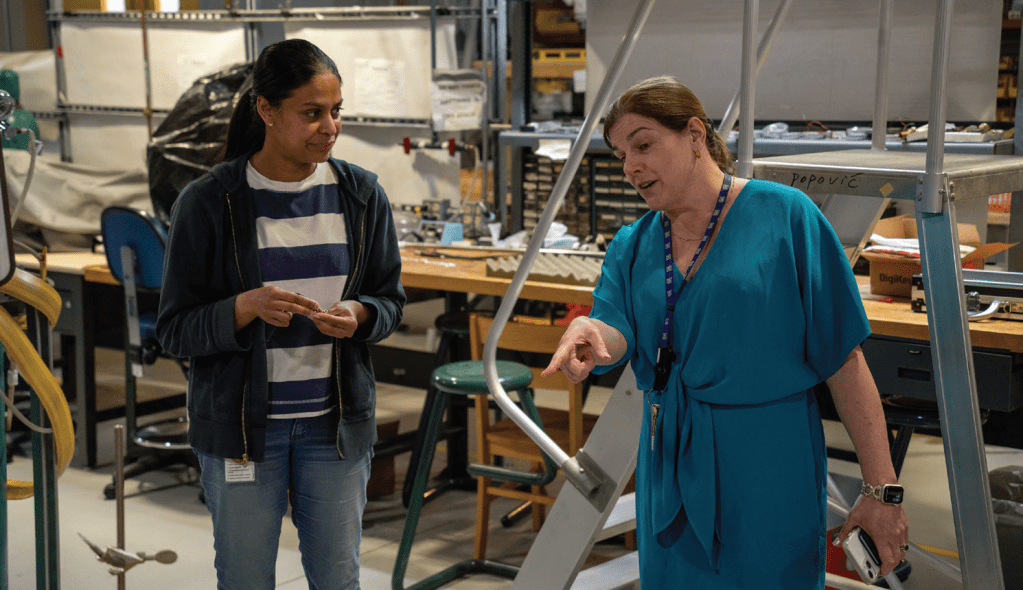
technical staff. Credit: National High Magnetic Field Laboratory
At Brookhaven National Laboratory, Amm worked with large cryogenic plants and aging infrastructure supporting magnet testing for accelerator upgrades and the Electron Ion Collider. The role emphasized leadership and operations over research with a focus on keeping complex systems running reliably while supporting demanding magnet programs. Today as director of the National High Magnetic Field Laboratory, she oversees one of the world’s most advanced cryogenic facilities supplying helium across a diverse research campus.
Looking back, Amm identifies three major shifts in the field. The first is the rise of high field MRI and parallel imaging which delivered faster, higher resolution scans while introducing new thermal challenges. The second is the emergence of fusion as a potential driver for high temperature superconductors, enabling compact high field magnets to operate at higher temperatures. The third is the rapid growth of quantum science and computing where cryogenics is central to scaling new technologies.
Throughout her career, Amm has emphasized education, professional service and international collaboration. She has served in leadership roles across major conferences, was president of the Applied Superconductivity Conference in 201, and currently serves on CSA’s board. She views reviewing, publishing and conference service as essential infrastructure for the field. She has worked with teams in China, Europe and across US national laboratories learning that large scale cryogenic systems are built as much on collaboration as on engineering.
From hand-transferred helium to global cryogenic infrastructure, Kathleen Amm’s career reflects the evolution of cryogenics from a specialized support function to a cornerstone of modern science, medicine and energy. Her work shows that the coldest technologies often have the warmest impact.