

by Bradley Moore, NASA – Jet Propulsion Laboratory, California Institute of Technology
The SpectroPhotometer for the History of the universe, Epoch of Reionization and ices Explorer (SPHEREx) is a passively cooled astrophysical observatory operating in a synchronous Low Earth Orbit (LEO). It is a planned 26-month mission that will map the entire sky four times in 102 color bands at near-infrared wavelengths. This all-sky mapping provides essential information on the large-scale structure of the universe and the distribution of interstellar ices (Bock, et al., 2026). The mission launched March 12, 2025, at 3:10 AM UTC and finished the first two all-sky surveys on May 14, 2026.
The last image we have of SPHEREx itself is shown in Figure 1, drifting into the lonely black.

The Coldest Passive Observatory in Low Earth Orbit
The sensitive infrared detectors require low temperatures to sufficiently control dark current for these measurements, specifically 62 K (-211°C, -348°F) for the three short-wave (SWIR) detectors and telescope, and 45 K (-228.15°C, -378°F) for the three mid-wave (MWIR) detectors. Passive cooling is employed to reach these very low cryogenic temperatures, to avoid the cost and system complexity of an active cooler.
The concept of utilizing deep space for passive cooling is not novel: as early as 400 BCE, Persian engineers used night-sky radiative cooling to freeze water in desert climates using yakhchāls. In modern spaceflight, multiple missions in interplanetary orbits (such as Spitzer) or at the second Earth-Sun Lagrange point (such as JWST, Planck, and Herschel) have passively achieved temperatures at or below those of SPHEREx, often supplementing these stages with active coolers or stored cryogens.
Historically, LEO instruments relying solely on passive cooling have struggled to achieve temperatures below 80 K, typically requiring active cryocoolers or cryogens for colder operations. The Diffuse Infrared Background Experiment (DIRBE) instrument on the COBE mission is a notable point of comparison, as it is the only other mission to record temperatures near those of SPHEREx without cryogens or a cryocooler. It warmed to a passive equilibrium of 43 ± 5 K roughly 250 days after depleting its liquid helium (Volz & DiPirro, 1992). However, this temperature applied only to its infrared detectors. Unlike COBE, SPHEREx is designed to passively cool the entire instrument to a stable operating temperature. Building on decades of heritage from cryogenic missions, SPHEREx leverages state-of-the-art analytical techniques and system-level thermal design to establish the coldest passively cooled observatory in LEO.
Engineering a Passive Cryogenic System
SPHEREx achieves this cooling with multiple passive stages. Three layers of V-groove type radiators block spacecraft emission, and environmental loads from the Earth and sun, and allow the radiators a view of the cold of deep space to reject heat radiatively. This design achieves temperatures of ~250 K, ~150 K, and ~100 K on the three shields from the outside to the inside, respectively. The conical shield geometry gives the observatory a distinctive martini glass shape. Inside the glass, the “olive” is the telescope, which is painted black and cools with the SWIR radiator to 62 K, and the MWIR detector with a large discrete open cell honeycomb radiator cooling to 45 K. Composite and titanium structural supports and low conductivity wiring span the thermal zones. Other than a telescope cover, which is deployed shortly after launch, there are no moving parts in the instrument and no propellant on the spacecraft. The repetitive slewing and pointing motions of the survey are achieved with reaction wheels recharged by magnetic torquer rods. An advanced survey algorithm (Bryan, et al., 2025) conducts the spectral mapping without the use of a steering mirror. The orbit and observatory were designed to safely deorbit passively after 25 years and burn up in Earth’s atmosphere consistent with NASA orbital debris requirements intended to minimize the generation of “space junk.”
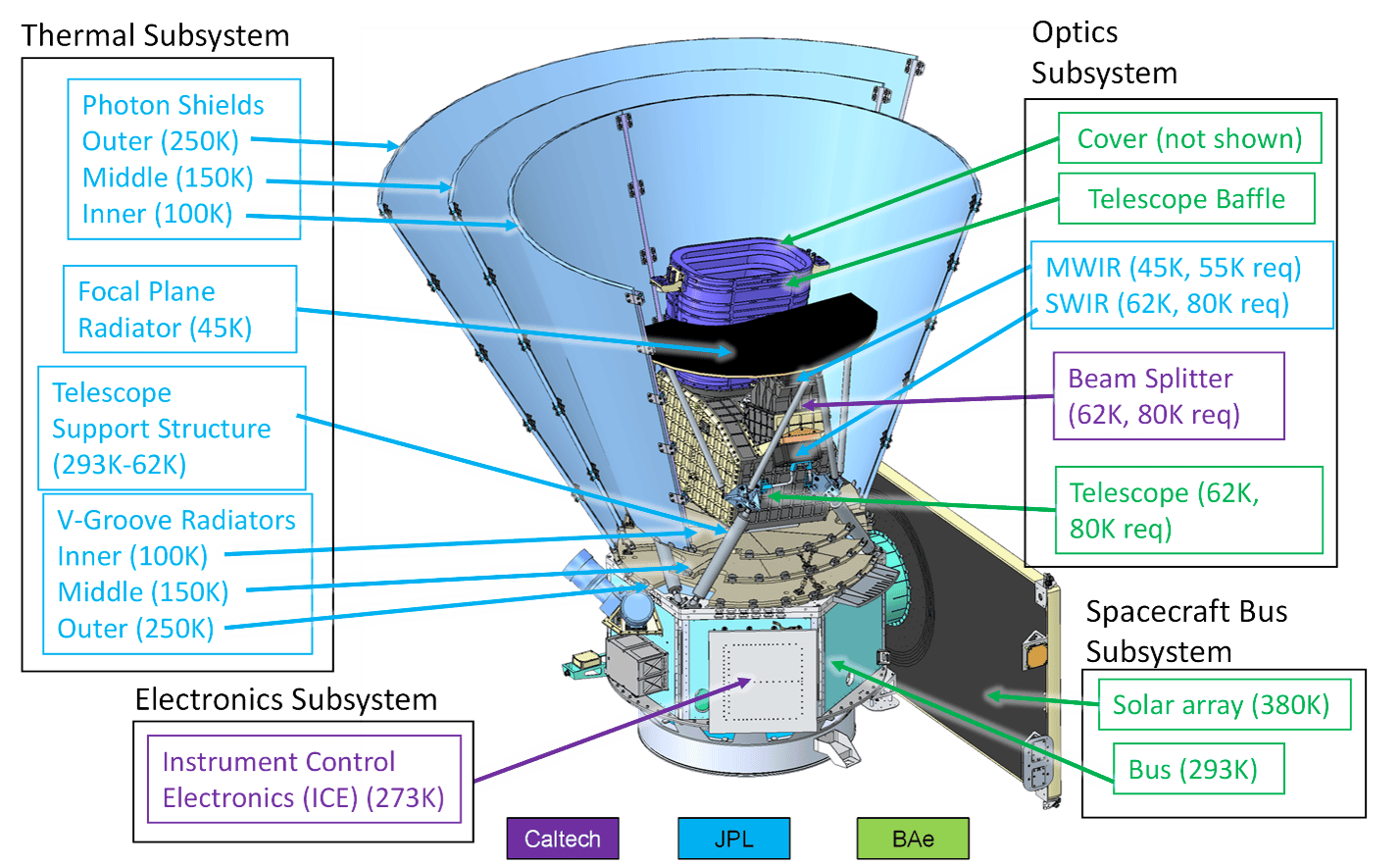
JPL provided the system-level integration, thermal subsystem, and both MWIR and SWIR focal plane arrays. Instrument testing was conducted at Caltech along with the design and construction of the dichroic beam splitter. The instrument electronics were built in partnership between Caltech and UC Berkeley. BAE Space and Mission Systems provided the telescope and spacecraft bus. The deeply integrated, complex, and unique JPL system-level design, coupled with the agile environment of Caltech, and reliable heritage from BAE enabled the SPHEREx mission.
One Year of On-Orbit Thermal Performance
Even with such a strong team, fitting an integrated, passively cooled system into a cost-capped mission was a challenge. Performance predictions relied heavily on modeling with no direct verification of the passive system. Only one thermal vacuum test was conducted with the complete thermal system in a liquid nitrogen environment (~77 K, well above the operational temperature), though a subscale test was conducted at operating temperatures. Instead, subsystem and higher-temperature tests (coupled with model correlation and physics-based extrapolation) provided the required prediction accuracy to ensure on-orbit performance.
When the mission launched in March 2025, the initial on-orbit results were surprising. The spacecraft initialized in an inertial reference frame, essentially pointing “north” throughout its orbit. Thus, the cryogenic radiators received drastically varying thermal loads as the view changed from staring at a warm earth and reflected sunlight vs. deep space over each orbit. This orientation was expected and modeled. The surprise however, was that the model had predicted much lower temperatures at this phase. Given the heavy reliance on thermal modelling, this was a great concern to the team. However, some rapid turnaround modelling determined that the latitude varying albedo used in prelaunch predictions was from a 1981 paper (Stephens, Campbell, & Haar, 1981) and averaged over the year in coarse latitude bins. Once this was updated with a current and much finer latitude resolved derived albedo from the CERES mission measurements (Kato, et al., 2025), the predictions snapped to measurements perfectly. This was a sign that, even in astrophysics, we need to understand and appreciate the effects of the climate of our home planet.
After this initial excitement, the observatory pointed to deep space to cool down to the operating temperatures. A plot of the cooldown and performance to date with an ~1-year time break is shown in Figure 3. The shift in cooldown rate is driven by decontamination heaters, which keep the optics warmer than surrounding components.
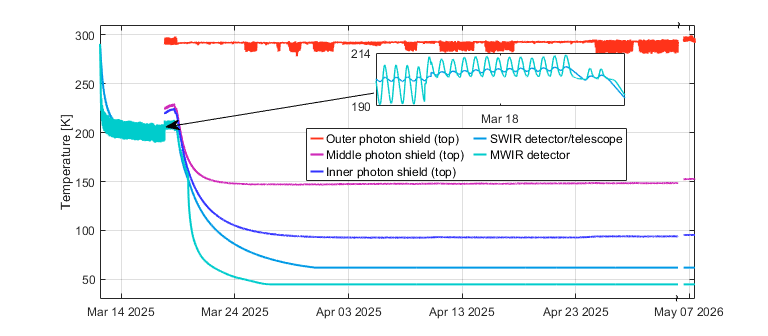
This thermal bias prevents volatile contaminants from migrating and condensing on the optical surfaces, critical for an instrument designed to measure cosmic ices. The cooldown behaved exactly as predicted, landing at temperature in 13 days vs. the predicted 13.7 days. There are no direct heat flow meters on the instrument, but the control heat required to hold the detector temperatures can be compared to the predicted values to determine model accuracy. Without any additional corrections in flight the model was accurate to within 3.9% for the SWIR detector and 5.5% for the MWIR detector of the estimated total heat load. The thermal design proved to be so robust and well understood that the pointing constraints could be relaxed to address higher-than-expected shuttle glow phenomena occurring on the leading edge of the observing range. Since the survey began, the active heating on the detectors has delivered exquisite temperature control, staying within 1 mK (millikelvin) on the MWIR detector and 5 mK on the SWIR detector, with the minimum heat applied of 36.4 mW (milliwatts) and 132.7 mW, respectively.
What SPHEREx Means for Future Missions
We will now be able to deliver ultra-stable cryogenic cooling to low earth orbit at a much lower temperature than previous missions. As with any low temperature cryogenic system there is a constant push and pull with the structural and radiated thermal parasitic loads. The V-groove radiator performance is limited by fairing size, mass, and observing scenario. Structural loads are driven by launch dynamics and instrument mass. The asynchronous design inherent in a large system coupled with flight mission risk posture drove SPHEREx thermal parasitics slightly higher than the minimum achievable. The next mission will hopefully push this envelope even further.
Despite the constraints, due to robust system margins, the thermal system is outperforming the initial temperature requirements of 55 K for the MWIR detector and 80 K for the SWIR detector by a substantial amount, achieving 45 K and 62 K respectively, including the dissipation from active temperature control. The thermal system has been operating perfectly for over a year and promises to continue to do so for years to come. In the end, it is enabling groundbreaking astrophysics, and that is what cryogenic cooling is about: providing a platform to achieve unprecedented science, engineering, and industrial innovation.
Acknowledgments
The research was carried out at the Jet Propulsion Laboratory, California Institute of Technology, under a contract with the National Aeronautics and Space Administration (80NM0018D0004). Reference herein to any specific commercial product, process, or service by trade name, trademark, manufacturer, or otherwise, does not constitute or imply its endorsement by the United States Government or the Jet Propulsion Laboratory, California Institute of Technology. Government sponsorship acknowledged.
More information is available at:
www.jpl.nasa.gov/missions/spherex and https://spherex.caltech.edu
References
- Bock, J.J., Aboobaker, A.M., Adamo, J., Akeson, R., Alred, J.M., Alibay, F., et al. (2026). The SPHEREx satellite mission. Astrophysical Journal, 999, 139.
- Bryan, S., Bock, J., Burk, T., Chang, T.-C., Crill, B.P., Cukierman, A., et al. (2025). Optimized observation sequencing in low-Earth orbit with the SPHEREx survey planning software. arXiv. https://arxiv.org/abs/2508.20332
- Kato, S., Loeb, N.G., Rose, F.G., Doelling, D.R., Rutan, D.A., Caldwell, T.E., et al. (June 2025). CERES EBAF Edition 4.2: Surface and top-of-atmosphere flux data. NASA Langley Research Center. https://ceres.larc.nasa.gov/data/
- Moore, B., Bolton, D., Penanen, K., and Susca, S. (2024). SPHEREx payload thermal architecture and analysis. IOP Conference Series: Materials Science and Engineering, 1301, 012014.
- Stephens, G.L., Campbell, G.G., and Van Haar, T. (1981). Earth radiation budgets. Journal of Geophysical Research: Oceans, 86, 9739-9760.
- Volz, S.M., and DiPirro, M.J. (1992). Anomalous on-orbit behavior of the NASA Cosmic Background Explorer (COBE) dewar. Cryogenics, 32, 77-84.


