ADVERTISEMENT

Booster 19 Rolls out to Masseys for Cryogenic Proof Testing

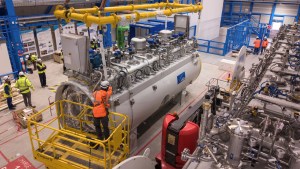
written by Ryan Weber  Following Booster 18’s failure during a pressure test, SpaceX went ahead and set a new record for stacking a booster in the Starship Program, to try and get Block 3 and the program at large back on track. And this weekend, crews rolled Booster 19 out to...

Provaris Delivers on First Phase LCO2 Tank Engineering and Design

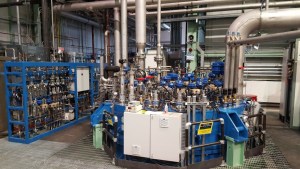
By Dominic Ellison  Australian hydrogen and carbon dioxide storage and transport firm Provaris Energy has completed the phase-one delivery of an LCO2 tank front end engineering and design (FEED) program. The programme included detailed engineering and material and weld testing of a 25,000 cbm LCO2 low-pressure tank and class approval with...

New Partnership with Druck set for Major Breakthrough in Hydrogen-Powered Aircraft

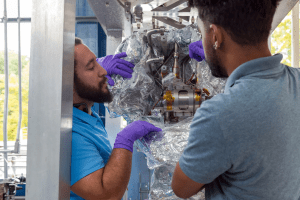
The University of Bath has entered a Knowledge Transfer Partnership (KTP) with Druck, a Crane Company business, to develop the world’s first flight-certified cryogenic hydrogen pressure sensor, helping pave the way for net-zero aviation. Hydrogen is one of the most promising solutions to decarbonising air travel, with aviation currently accounting...

In Memoriam: Dr. Ray Radebaugh

It is with deep sadness that we share the passing of Ray Radebaugh. Ray was a pioneer, mentor, and friend whose influence on cryogenics spanned more than five decades and touched nearly every corner of our field. Ray’s passion for engineering began early. Growing up in Mishawaka, Indiana, he learned...

New Cryogenic Vacuum Chamber Cuts Noise for Quantum Ion Trapping

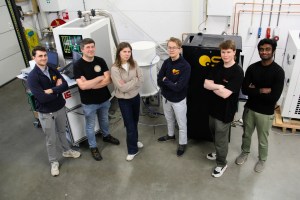
by John Toon, Georgia Institute of Technology Even very slight environmental noise, such as microscopic vibrations or magnetic field fluctuations a hundred times smaller than Earth’s magnetic field, can be catastrophic for quantum computing experiments with trapped ions. To address that challenge, researchers at the Georgia Tech Research Institute (GTRI)...

Remembering Bruce P. Strauss, a Steward of the Superconductivity Community

The superconductivity community has lost one of its most devoted stewards with the passing of Bruce P. Strauss, whose career spanned more than five decades and whose influence reached far beyond his own technical work. Bruce was not only a contributor to applied superconductivity; he was a builder of the...

ADVERTISEMENT

Joule-Thomson Effect

The Joule-Thomson (JT) effect is a thermodynamic process that occurs when a fluid expands from high pressure to low pressure at constant enthalpy (an isenthalpic process). Such a process can be approximated in the real world by expanding a fluid from high pressure to low pressure across a valve. Under...

Current Leads

One of the challenges of using superconducting magnets is the connection of the magnet to a room temperature power supply. This is accomplished via current leads. The trick is that current leads should ideally have a low heat leak, since they connect room temperature to cryogenic temperature, while at the...

Multilayer Insulation

Multilayer insulation (also referred to as superinsulation) is a key component in the reduction of heat leak to cryogenic systems due to thermal radiation. MLI consists of a series of uncooled reflective surfaces placed in the vacuum space between two surfaces, one warmer than the other. Generally speaking, for ideal...

Air Separation and Liquefaction

by Nils Tellier, PE, President, EPSIM Corporation (CSA CSM) nils@epsim.us All illustrations courtesy EPSIM Corporation Background History of Air Separation and Liquefaction This section builds on a rich history of methods to develop deep refrigeration and cryogenic liquefaction during the 19th Century. You are encouraged to read Cryo Central’s History...

Bose-Einstein Condensate

A Bose-Einstein condensate, first proposed in 1925 by Albert Einstein based on work done by Satyendra Nath Bose (the same Bose from whom the term boson is derived), is a super-cold state of matter in which almost all of the individual atoms have “condensed” down to the lowest possible quantum...

Cold Technology for Pest Control

While it does not reach temperatures cold enough to be called cryogenic, carbon dioxide snow is at the heart of a new way of dealing with unwanted pests. It utilizes a quick freezing process that takes advantage of the properties of carbon dioxide snow and has a number of benefits...

Cryogenic Finishing

The following 3 articles discuss the uses and procedures of various type of cryogenic finishing. 1) By Robin A. Rhodes, Cryogenic Institute of New England, Inc. rrhodes@nitrofreeze.com Cryogenic Deflashing is employed to remove undesired residual mold flash that remains on molded parts after they are removed or ejected from the...