ADVERTISEMENT

Thermoelectric Heating Comes In From the Cold

Before architect César Martín-Gómez could send his latest thermoelectric experiment to Antarctica in 2018, he had to make sure that soldiers from the Spanish Army could get it right on the first try. In the laboratory, he could always run the experiment—a scale model of a solid-state thermoelectric heater—a second time if...


Artificial Intelligence and NASA’s First Robotic Lunar Rover

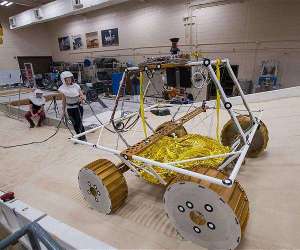
When NASA’s VIPER (short for Volatiles Investigating Polar Exploration Rover) lands on the surface of the Moon on a mission to better understand the environment where NASA plans to send astronauts as part of the increasingly complex Artemis missions, its journey will be guided by the ingenuity of its human...

DARPA-Funded Research Leads to Quantum Computing Breakthrough

A team of researchers working on DARPA’s Optimization with Noisy Intermediate-Scale Quantum devices (ONISQ) program has created the first-ever quantum circuit with logical quantum bits (qubits), a key discovery that could accelerate fault-tolerant quantum computing and revolutionize concepts for designing quantum computer processors. The ONISQ program began in 2020 seeking...

Wyoming Already Produces 20% Of The World’s Helium, And Likely Has A Lot More

CSA April Newsletter SponsorHigh-performance, highly reliable, long-lasting storage tanks for transporting hydrogen & helium molecules around the globe.​https://www.gardnercryo.com [Contact Jamie Luedtke for Newsletter Sponsorship] Home About Membership Login Calendar Cold Facts Buyer’s Guide News Publications Cryo Careers Resources Donate Join now Log in Cryogenic Society of America, Inc. Twitter Facebook...

ADVERTISEMENT

Mixed Refrigerant Cycles

Most cryogenic refrigeration systems, both large scale systems and cryocoolers, use helium as a working fluid. There are a number of advantages to helium, not the least of which is that helium remains a fluid down to the lowest achievable temperatures. In order to freeze helium, pressures of over 20...

Fountain Pumps and He II Phase Separators

Helium II (He II), the second liquid phase of the 4He isotope described in this column in Cold Facts Spring 2010 (http://2csa.us/he2), can be modeled as consisting of two interpenetrating fluids. One, the superfluid component, has zero viscosity and entropy and the other, the normal fluid component, has nonzero viscosity...

Turboexpanders

A vital technology in the refrigerators and liquefiers described in Cold Facts Volume 31 Number 3 is that of turboexpanders. These devices are rotating machines in which the process fluid (e.g., helium) does work against the turboexpander while moving from high pressure to a lower pressure and thus is cooled....

Air Separation and Liquefaction

by Nils Tellier, PE, President, EPSIM Corporation (CSA CSM) nils@epsim.us All illustrations courtesy EPSIM Corporation Background History of Air Separation and Liquefaction This section builds on a rich history of methods to develop deep refrigeration and cryogenic liquefaction during the 19th Century. You are encouraged to read Cryo Central’s History...

Bose-Einstein Condensate

A Bose-Einstein condensate, first proposed in 1925 by Albert Einstein based on work done by Satyendra Nath Bose (the same Bose from whom the term boson is derived), is a super-cold state of matter in which almost all of the individual atoms have “condensed” down to the lowest possible quantum...

Cold Technology for Pest Control

While it does not reach temperatures cold enough to be called cryogenic, carbon dioxide snow is at the heart of a new way of dealing with unwanted pests. It utilizes a quick freezing process that takes advantage of the properties of carbon dioxide snow and has a number of benefits...

Cryogenic Finishing

The following 3 articles discuss the uses and procedures of various type of cryogenic finishing. 1) By Robin A. Rhodes, Cryogenic Institute of New England, Inc. rrhodes@nitrofreeze.com Cryogenic Deflashing is employed to remove undesired residual mold flash that remains on molded parts after they are removed or ejected from the...

Need help comparing chest freezers and upright freezers

Currently we use in our Biobank an upright -80 freezer to store all our samples. We are planning to buy a fully automated bio-repository storage that will do the picking of samples under restricted conditions. But in the meantime I foresee that we have to pick the samples manually. The...

Need recommendations for cryogenic vials

I am looking into standardizing our range of bio storage tubes (cryogenic vials). These will be for both blood and tissue samples and their derivatives. Any recommendations, comments on Micronics, Nalgene, Nunc and or others that are suitable for long term -80 C and -196 C storage, DNA/RNA suitable, would...

We need a custom machine for flash freezing of water

We are an ice making company and have started a new project, which is related to flash freezing of water. It is based on cryogenics technology and we need a custom made machine. I would kindly ask you to pass me a few companies who would be interested in such...

Looking for a pump suitable for cold liquids

I would like to construct a small cooling circuit (appr. 50 x 50 cm) pumping liquid at a temperature down to -120°C from a cold reservoir to the specimen to be cooled. The tubes and connections are not a problem, but does somebody know a pump (suction/compression for circulation) suitable...