ADVERTISEMENT

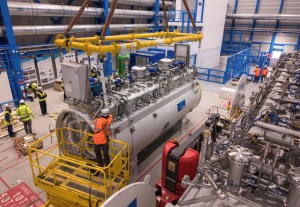
Figure 1: Electron Ion Collider. Credit: Brookhaven

Brookhaven Expands Cryogenic Capabilities for the Electron-Ion Collider Project

by Chintan Sheth, Mechanical Engineer, PMP, Brookhaven National Laboratory The Relativistic Heavy Ion Collider (RHIC) has been running successfully since the year 2000 at the U.S. Department of Energy’s (DOE) Brookhaven National Laboratory (BNL). 2025 will be RHIC’s final run, and the facility will be decommissioned after the run ends...
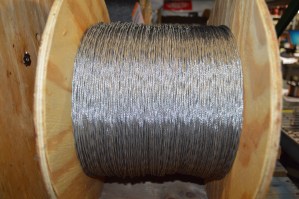
ALLVAR Alloy 30 expands when cooled, the opposite of invar and aluminum, and maintains negative thermal properties at cryogenic temperatures. Credit: Allvar

ALLVAR Alloys Solve Cryogenic Mismatch

ALLVAR Alloy 30 expands when cooled, the opposite of invar and aluminum, and maintains negative thermal properties at cryogenic temperatures. Credit: Allvar by James A. Monroe, Ph.D., ALLVAR Almost all materials expand when heated and contract when cooled, known as positive thermal expansion. Some materials expand and contract a lot...
Ice Cure medical Logo

IceCure Receives Notice of Patent Allowance in China for a Novel Cryogen Flow Control to Optimize Patient Cryoablation Outcomes

IceCure Medical Ltd., developer of minimally invasive cryoablation technology that destroys tumors by freezing them, announced that it has received a Notice of Allowance from the China National Intellectual Property Administration (CNIPA) for a new patent titled “Cryogen Flow Control.” The patent relates to IceCure’s next-generation XSense™ cryoablation system and...
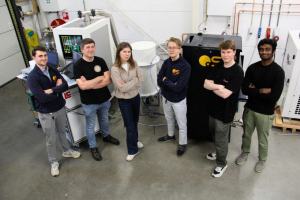
Professor Stefanie Gutschmidt, Head of UC’s Department of Mechanical Engineering, and UC Principal Researcher Dr Alan Caughley run the cyrocooler technology in the new CryoLab. Credit: UC Canterberry

UC Launches New Lab to Advance Cryogenics Research

University of Canterbury News The University of Canterbury (UC) has launched a new lab dedicated to cryogenics research and consultancy. CryoLab is now Aotearoa New Zealand’s only cryogenics research group combining advanced cryogenic refrigeration research with consulting to industry in cryogenics, fluid mechanics, and thermodynamics. Cryogenics is the science of...
Quantum Design Acquires Oxford NanoScience, Joining Two Historic Cryogenic Companies

Quantum Design Acquires Oxford NanoScience, Joining Two Historic Cryogenic Companies

Quantum Design (QD) is pleased to announce the completion of the acquisition of the Oxford NanoScience division of Oxford Instruments. This acquisition unites two industry leaders with a combined legacy of more than 100 years of experience and innovation in cryogenics, materials science, and microscopy. The expanded, shared product catalog...

ADVERTISEMENT

Dewar

A dewar is a type of cryostat named after Sir James Dewar, the researcher who first developed the concept of a vacuum insulated container with silvered walls to reflect thermal radiation. Dewar was the first to liquefy hydrogen, and he created the device to store his discovery. The thermos bottle...

Stirling and Gifford-McMahon Cryocoolers

Stirling and Gifford-McMahon (GM) cryocoolers are two of the most commonly used cryocoolers in cryogenics. Both devices have a significant industrial base and operate at a wide range of temperatures and capacities. The thermodynamic cycles for both of these cryocoolers are quite similar. The Stirling cycle consists of a compressor,...

Liquefied Natural Gas (LNG)

A significant commercial application of cryogenics is the liquefaction, transport and storage of natural gas. Liquefied Natural Gas (LNG) is generally 95 percent methane with a few percent ethane and much lower concentrations of propane and butane. LNG liquefies at 111.6 K. Unlike many applications of cryogenics, the motivation for...

Cryogenic Treatment of Materials

F.J. Diekman Controlled Thermal Processing, Inc. info@metal-wear.com Cryogenic Processing (also called cryogenic treatment, and incorrectly “cryogenic tempering”) is a process that uses cryogenic temperatures to modify materials to enhance their performance. Cryogenic Processing involves the slow reduction in temperature of the material to at least -300°F (-185°C) and holding the...

Cryogenics in Space

Peter Kittel University of California-Berkeley pkittel@cal.berkeley.edu Space Cryogenics is the application of cryogenics to space missions. These applications fall into two broad areas, supporting space science missions and supporting the space transportation infrastructure. Science applications: The atmosphere is opaque to much of the electro-magnetic spectrum. In space, the absence of...

Cryosurgery

Review of Cryosurgery Boris Rubinsky, PhD Hebrew University School of Science and Engineering Research Center for Biomedical Engineering 78b Ross Building Givat Ram, Jerusalem 91904 Israel rubinsky@cs.huji.ac.il as published in Annual Review of Biomedical Engineering, August 2000, Vol. 2, pp. 157-187. Abstract: Cryosurgery is a surgical technique that employs freezing...

Liquefied Natural Gas

Liquefied Natural Gas as it relates to the Field of Cryogenics John W. Bonn VJ Systems, LLC johnbonn@vjsystems-lic.com Today the world is looking for a cleaner fuel and Liquefied Natural Gas (LNG) plays a large part in achieving this goal. LNG in a liquid form is at -162°C (-259°F) and...

What is the temperature range of cryogenics?

Could you please tell me what is the temperature range of cryogenics? In other words, is -100°F considered cryogenic, or does it start lower? Could I expect to see some extended life in D2 stamping dies? What would the recipe be to achieve the desired results using cryogenics?