by Wesley Johnson, NASA Glenn Research Center
Here on our home planet, where we have been liquefying various “permanent gasses” since 1877 [1], most of us take it for granted that when we go out to buy a cryogenic liquid (or even a pure gas) we don’t have to write our own specification for what the allowable contaminants are. Instead, we pull up the Mil-specs and decide what grade we need. [2-4] These specifications have been repeatedly refined over the years as the industrial gas process plants that purify the gas and liquid products improve. This also helps the company that is designing and building a plant, as they can take appropriate air quality measurements to define what contaminants are present and build in the appropriate filtering systems accordingly. Failure to get the measurements accurate enough (or if a new industrial plant moves in changing the contaminants) can cause costly changes for a plant.
However, leaving Earth behind and looking at production on other planetary bodies, the specification process is much less well defined. For the moon, there is no atmosphere, so the fluid production must use what is in the local regolith (a word that represents what we call “dirt” on Earth, but without the organic and life compounds). We have returned samples for study back on Earth from 11 locations: the six locations for the Apollo manned missions, three locations from the Soviet Luna spacecraft, also in the 1960s, and two locations returned by the Chinese (including the first sample from the far side of the moon). [5, 6] The location of these samples (see Figure 1) are not representative of the wider geology of the moon or of where NASA wants to land the Artemis missions, near the craters of the South Pole. [7] The LCROSS mission [8] did take measurements after crashing an upper stage into a polar crater, but that is just one sample. The VIPER rover, having gone through cancellation and several re-manifests in the last year, is currently scheduled to take in-situ measurements at the lunar poles after launch in 2027. [9] For Mars, we have samples measured robotically in the different locations where rovers have taken place in-situ. [10] The coverage of these sampled locations may not be indicative of where a production plant might be built. Thus, we are left with many unknowns even before we consider what processes might be used.

Another consideration that must be taken into account is what product the end-user can tolerate. Most studies indicate the initial user of the fluids generated on these surfaces will be returning landers through propulsion. [11] Initial studies on the actual engines themselves have shown robust tolerances to consumable impurities. [12] The subsystem just upstream of the engine consists of the cryogenic propellant liquefaction and storage systems, so exploration of the tolerance of these systems to impurities is required. Given the wide range of processes for the production of gases (electrolysis, [13] molten regolith electrolysis, [14] and carbothermal oxygen production [15]), the actual contaminates could be as varied as the sample locations across the lunar surface. Thus, a simplified method of characterization of contaminates must be identified to allow for understanding of the wide variety of possible impurities.
To accomplish this, we look at the relative impacts of different types of fluids based on their phase and relative density and come up with the following table with four main categories. Table 1 shows the fluid impurities by phase and density grouped together by like impacts (colors).
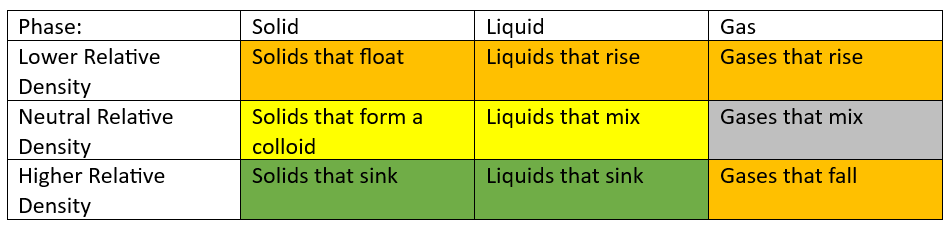
From a liquefaction process perspective, the solids and liquids that sink (green boxes) occupy a volume at the bottom of the system and can be removed through a draining process. The solids and liquids that mix within the main fluid (yellow boxes) don’t affect the liquefaction process but may cause issues if they become too concentrated in the bulk liquid for consumption. Gases that are neutrally buoyant (grey box) will simply accumulate in the vapor space of the system and will need to be vented when they reach a certain concentration. The remaining four conditions (orange boxes) will directly affect the phase change process of the liquefaction system: Solids and liquids that rise by interrupting the phase equilibria at the interface, gases that rise and fall respectively by impeding or aiding the motion of the condensate film on the wall of the condenser. Additional considerations include, but are not limited to, the reactivity of the contaminant with the bulk fluid and the relative likelihood of the gas to dissolve into the liquid.
Measuring the effects of the four conditions as a function of contaminant quantity, especially those in the vapor phase are critical for understanding liquefaction operations and the allowable contaminants, both as they build up and interact within the system. As NASA develops liquefaction operational concepts and demonstrations, these contaminations need to be taken into account. Initial CryoFILL brassboard LN2 testing showed possible substantial impact of helium contamination in the ullage. [16] Further testing with helium and other contaminants is needed to understand the orange boxes in Table 1. Follow-on tests for CryoFILL have identified helium and argon as possible gases that can answer questions on the gases that rise and gases that fall items. Water vapor was considered to address solids that float, but due to concerns with build-up in undesirable locations, has been deferred to future testing.
References:
[1] R. G. Scurlock (ed), “History and Origins of Cryogenics,” Oxford University Press, 1993.
[2] MIL-PRF-27210J, Oxygen, Aviator’s Breathing, Liquid and Gas, 2013.
[3] MIL-PRF-27401H, Propellant Pressurizing Agent, Nitrogen, 2024.
[4] MIL-PRF-27201F, Propellant, Hydrogen, 2022.
[5] C. Li, H. Hu, M.-F. Yang, et al, Characteristics of the lunar samples returned by the Chang’E-5 mission, National Science Review, Volume 9, Issue 2, February 2022, https://doi.org/10.1093/nsr/nwab188
[6] C. Li, H. Hu, M.-F. Yang, et. al, Nature of the lunar far-side samples returned by the Chang’E-6 mission, National Science Review, Volume 11, Issue 11, November 2024, https://doi.org/10.1093/nsr/nwae328
[7] About Human Landing System Development, https://www.nasa.gov/reference/human-landing-systems/
[8] K M Luchsinger, N J Chanover, and P D Strycker, “Water within a permanently shadowed lunar crater: Further LCROSS modeling and analysis”, Icarus, Volume 354, 2021, 114089, ISSN 0019-1035, https://doi.org/10.1016/j.icarus.2020.114089.
[10] S. T. Stroble, K. M. McElhoney, S. P. Kounaves, “Comparison of the Phoenix Mars Lander WCL soil analyses with Antarctic Dry Valley soils, Mars meteorite EETA79001 sawdust, and a Mars simulant”, Icarus, Volume 225, Issue 2, 2013, Pages 933-939, ISSN 0019-1035,
[11] J. Sanders and J. Kleinhenz, “In Situ Resource Utilization (ISRU) Envisioned Future Priorities”, updated March 9, 2023. https://www.nasa.gov/wp-content/uploads/2023/06/live-isru-efp-new-3-21-23-tagged-1.pdf
[12] E Jacobs, “Standards for Impure Propellants”, NASA contract 80NSSC20C0307, 2020.
[13] A Paz, “Technology Assessment for Producing Propellant from Lunar Water”, presented at the NASA Exploration Science Forum (NESF2023), July 18-21, 2023. https://ntrs.nasa.gov/citations/20230010039
[16] J G Valenzuela, “Cryogenic In-Situ Liquefaction for Landers, “Brassboard” Liquefaction Testing Series”, NASA TM 20210010564, 2021.