by Quan-Sheng Shu, cryospc.com and Jonathan Demko, Le Tourneau University
Superconducting (SC) motors are pivotal for future transportation, offering power densities exceeding 20 kW/kg. Cooling philosophies diverge by architecture: partially superconducting aircraft designs (like NASA’s HEMM) utilize integrated mechanical cryocoolers for the rotor, whereas fully superconducting aircraft favor liquid hydrogen (LH2) as a heat sink to eliminate refrigeration weight as shown in Figure 1 (A) and (B). For maritime propulsion, large-capacity mechanical cryocoolers remain the standard, as shipboard environments prioritize autonomous reliability over extreme mass reduction. This architecture supports a dual-temperature core: a 20 K MgB2 stator and a 50 K REBCO rotor, managing mechanical stresses up to 150 MPa. This article reviews advances in HTS to ensure reliability. Part I of the article focuses on review of future aircraft, where the synergy among LH2, HTS materials and cryogenic systems is essential for lightweight, zero-emission flight. These achievements mark critical steps toward robust, large-scale SC propulsion.
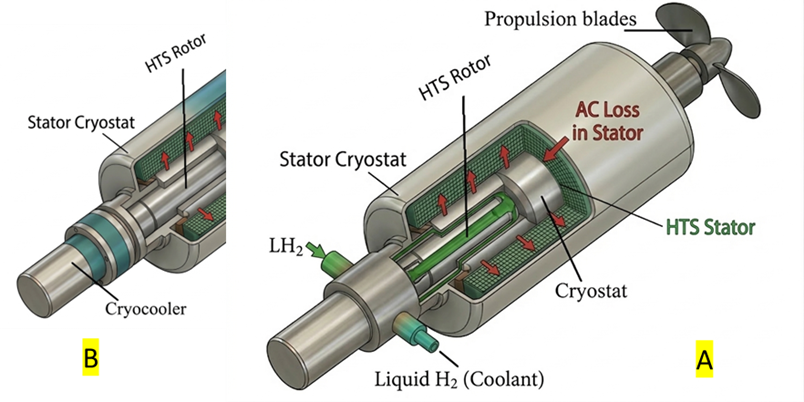
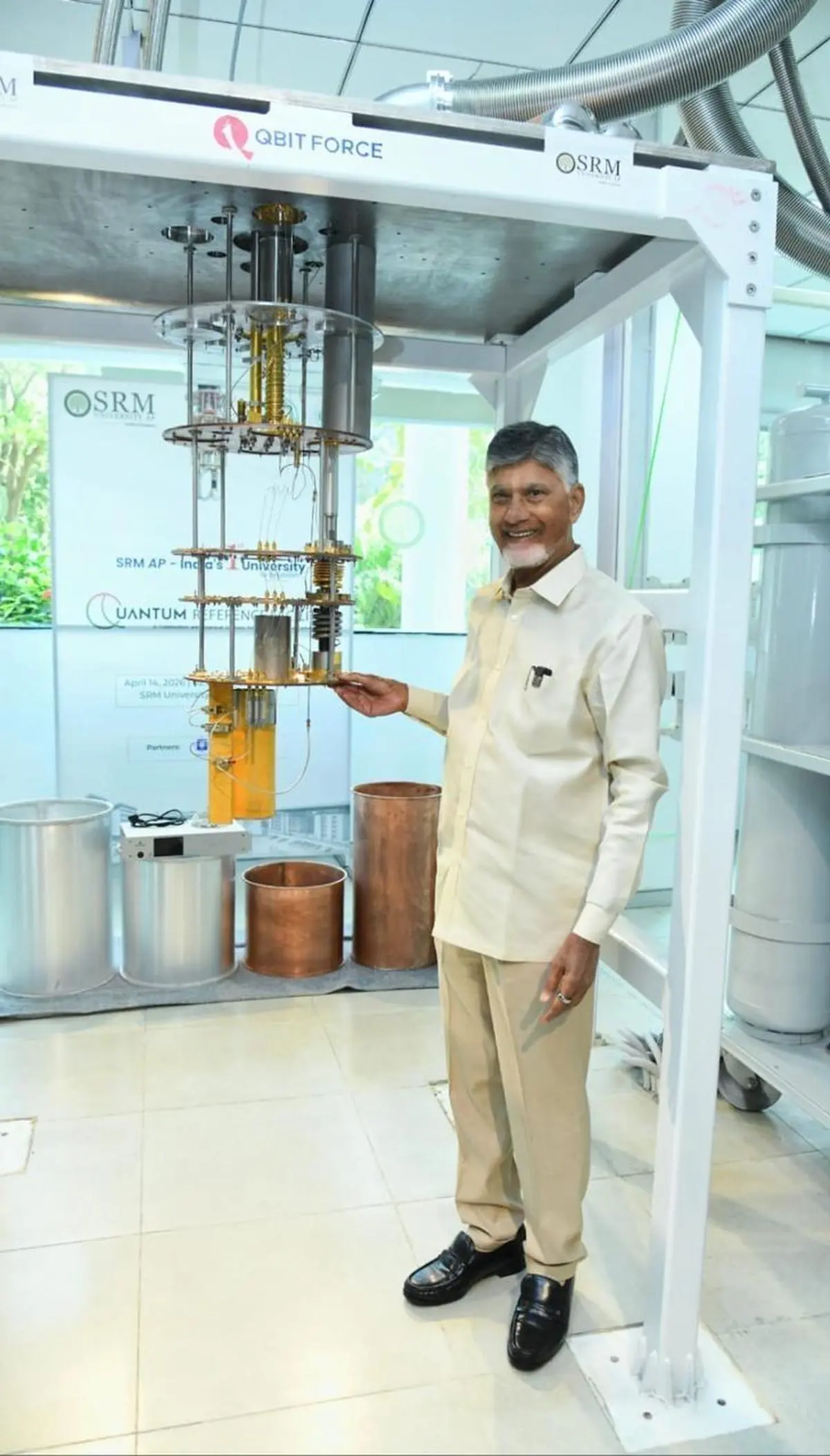
cryocooler. Credit: Shu and Demko
General Design Consideration
Over the decades, many R&D efforts, proposals, and preliminary designs have emerged from national laboratories, research institutions, universities, and industries, focusing on key components such as rotational cryocoolers, cryogenic liquid heat sinks, superconducting (SC) motors, and integrated aircraft systems (Figure 2). The general design considerations include the following (not exclusively):
• Overall concept of SC motor with aircraft
• Rotating cryocooler architecture
• Other cryogenic thermal sinks, such as LH2
• Thermal anchoring to the rotor and coils
• Thermodynamic performance and efficiency with trade studies
• Mechanical and reliability considerations
• Comparison with stationary cryo cooler approaches
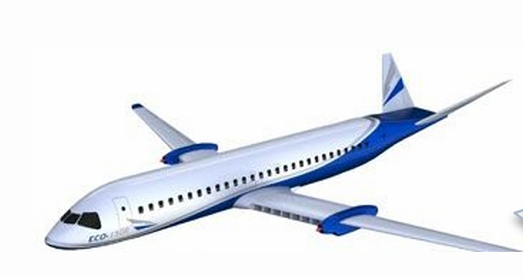
both superconducting and ambient temperature systems.[2] Credit: Madavan
Representative Motor Thermal and Electrical Data
Megawatt‑class superconducting motors for aviation employ HTS DC field coils in the rotor and MgB₂ AC armature windings in the stator to achieve high power density as show in Figure 3.[3] The refrigeration challenge is driven by stringent mass limits and the distinct thermal environments required by these two superconducting subsystems. Caughley et al. presented the following representative reference data. [3-6]
Heat Load Budget. For a 3 MW motor, the total heat load is divided as follows: (1) Rotor (50 K) requires 55 W of cooling (includes a 100% safety margin). Primary loads include drive shaft conduction (15 W), viscous losses from coolant circulation (5 W), and HTS joint heating (3.75 W). Use of a flux pump eliminates current lead losses. (2) Stator (20 K) requires a much higher 3.272 kW capacity (100% safety margin). The dominant load is AC hysteresis loss (~1 kW) in the coils, followed by pumping/viscous losses (~600 W) required to circulate the coolant.
Heat Sink Temperature Choices. Three thermal sinks are analyzed to reject the motor’s heat: (1) Ambient (300 K). Readily available but leads to heavy, inefficient refrigeration systems for the stator. (2) LNG (120 K). Pressurized liquid methane offers a lower temperature sink, improving cryocooler COP. (3) LH2 (23 K). Liquid hydrogen provides massive latent heat sinking (~98 kW potential), matching the fuel requirements of zero-emission aircraft.
Cooling Methods. (1) Rotor Cooling. For ambient sinks, a rotating Stirling cryocooler (e.g., DS30-type) is practical, weighing ~29 kg. With an LH2 sink, the rotor can piggy-back off the stator’s cooling loop, as 50 K is easily maintained through simple gas circulation. (2) Stator Cooling: Mechanical refrigeration at 300 K is unviable, adding ~8.9 tons per motor. The preferred method utilizes liquid hydrogen with an intermediate gaseous helium loop. By using a Joule-Thompson (JT) valve and the latent heat of LH2, the stator can achieve 20 K with high reliability and significantly lower system mass. Since the fuel H2 is already at 20 – 23 K, it provides “free” cooling via heat exchangers and a simple helium loop, enabling the 30 kW/kg power density target.
The Promise of Superconducting Motors for Aircrafts
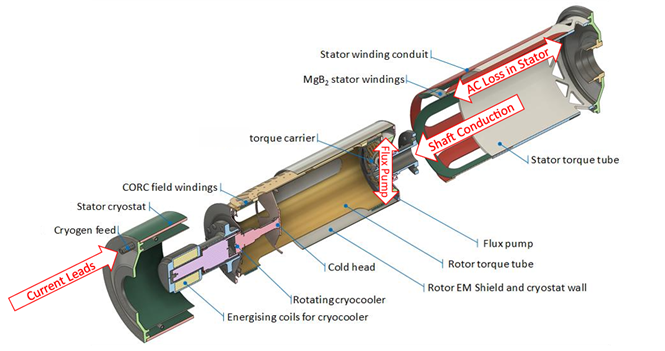
While fully superconducting (SC) motors for aircraft face significant challenges – primarily high AC losses in the stator that demand heavy cryogenic systems – partially SC motors offer a more viable path forward.[4-7] By restricting superconductivity to specific components, engineers can maximize power density while simplifying thermal management. A primary example is NASA’s High Efficiency Megawatt Motor (HEMM) as shown in Figure 4.[4] This 1.4 MW wound-field synchronous machine utilizes DC superconducting rotor windings paired with a slot-less stator. Because the rotor carries a steady DC current, it avoids the AC loss penalty, allowing for a 99% efficiency rating and a specific power of 16 kW/kg. Crucially, its self-cooled design integrates with standard aircraft cooling, bypassing the massive weight penalties typically associated with fully SC machines.
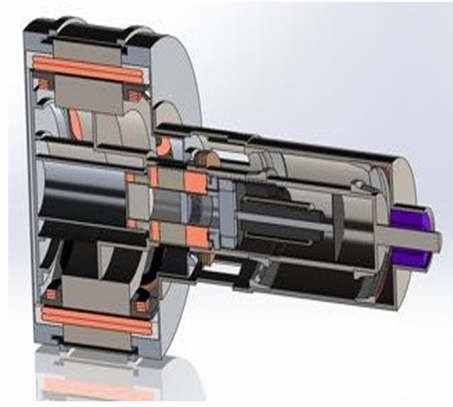
While the HEMM is a landmark in partially superconducting (SC) motor design, several other major projects are exploring different architectures – ranging from “fully superconducting” demonstrators to “flux-trapping” bulk magnets. The ASuMED Project (advanced SC motor experimental demonstrator), a European Union-funded project, developed a 1 MW motor that is often cited as the first “fully” superconducting motor prototype for aircraft. It uses high-temperature superconducting (HTS) windings in both the rotor and the stator (Figure 5).[4]
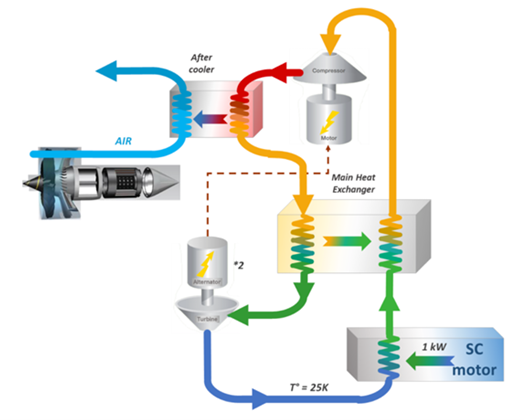
Advances in Cryocooling
The use of superconductive/cryogenic components in motors/generators requires technologies to cool them to cryogenic operational temperatures. This can be achieved using individual or a combination of traditional methods including cryocoolers, cryogenic liquids, and solids cooled below melting points. To achieve cryocooling, a cooling source is necessary in addition to ancillary technologies such as cryogenic shielding, vacuum technologies, thermal engineering and control, sensors, and others. Comprehensive review articles describe cryocooler properties including cooling performance, mass and size, cost, and lifetime and reliability.[5-9] Cryocooler power density, efficiency, and size can all become critical factors affecting system viability. These factors are also referred to generally as the size, weight and power (SWaP) properties. Figure 6 plots the inverse of power density of the cryocoolers and shows that there are significant differences in machine design and impact on power densities.

Reference
[1] Shu, Q.-S. et al., 1989. Applications in Superconducting Motors and Generators (Chapter 9), in Superconducting Engineering. Beijing: Press of Machinery Industry. ISBN 7-111-00173-7/TM.36.
[2] Madavan, N., 2017. A NASA Perspective on Electric Propulsion Technologies for Future Generations of Large Commercial Aircraft. Plenary presentation, CEC-ICMC 2017, July 2017, Madison, WI.
[3] Caughley, A., Lumsden, G., et al., 2024. Cooling of Superconducting Motors on Aircraft. Aerospace, 11, 317. MDPI.
[4] Grilli, F., et al., 2020. Superconducting motors for aircraft propulsion: The Advanced Superconducting Motor Experimental Demonstrator project. Journal of Physics: Conference Series, 1590, 012051.
[5] Caughley, A., Allpress, N., et al., 2023. Cooling method for the rotor of a superconducting motor. IOP Conference Series: Materials Science and Engineering, 1301 (2024), 012008. CEC-2023.
[6] Haran, K., et al., 2017. High power density superconducting rotating machines: Development status and technology roadmap. Superconductor Science and Technology, 30, 123002.
[7] Jeong, S., Kim, B., et al., 2021. Holistic approach for cryogenic cooling system design of 3 MW electrical aircraft motors. AIAA Propulsion and Energy Forum, 1–9.
[8] Wilson, K., Wade, J., and Mansfield, D., 2018. Sunpower DS-30 Cryocooler Development. In Cryocoolers 20, pp. 135–141.
[9] Dyson, R., Jansen, R., Duffy, K., and Passe, P., 2019. High efficiency megawatt machine rotating cryocooler conceptual design. AIAA Propulsion and Energy Forum and Exposition, 1–15.