ADVERTISEMENT

Call for Photo Submissions: Support the AIP Visual Archives

AIP is working to enrich Niels Bohr Library & Archives collections by improving the documentation of women and underrepresented people in the physical sciences.  They collect visual documentation of the personal and professional lives of physical scientists. Their collection contains images of modern American physicists, astronomers, geophysicists and many other kinds of scientists.   In general, they...
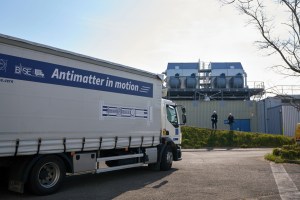
BASE Experiment at CERN Succeeds in Transporting Antimatter

Today, in a world first, a team of scientists from the BASE experiment at CERN successfully transported a trap filled with antiprotons in a truck across the Laboratory’s main site. The team managed to accumulate a cloud of 92 antiprotons in an innovative portable cryogenic Penning trap, then disconnect it from the...

Solving a Mystery in Dark Matter Detectors Could Improve Quantum Computers

By Lauren Biron Although dark matter makes up most of the mass in our universe, it has never been directly observed. To hunt for lighter dark matter and other rare phenomena, researchers must solve a puzzle in their supersensitive detectors: an unexpected number of low-energy events, called the “low-energy excess”...

Hydrogen Aviation Advances With Airbus and RWTH Aachen’s GENtwoPRO Fuel Cell Project

By Erin Kilgore If you’ve been tracking the future of hydrogen aviation, you know it’s a path packed with big ideas and tricky engineering puzzles. Now, Airbus and RWTH Aachen University have kicked off an Airbus RWTH Aachen partnership laser-focused on a near-term, high-impact goal: using scalable fuel cell technology to power regional aircraft. Early in Airbus’s hydrogen journey,...

ADVERTISEMENT

Transfer Lines

Transfer lines may in some real sense be thought of as the cryogenic fluid analogy of current leads. While current leads carry electrical power to where it’s required in a cryogenic system, transfer lines do the same with cryogenic fluids. Transfer lines range in complexity from very simple U-tubes containing...

Zero Boiloff

Zero Boil Off cryostats are those that contain liquid cryogens but are designed to eliminate or vastly reduce the boil off of  the liquid. These cryostats combine some of the advantages of Cryogen-Free systems (e.g. ease of use and long operational lifetime) with the advantages associated with a reservoir of liquid...

Cryomodule

Cryomodule is a term that is most commonly used to refer to cryostats that contain superconducting radio frequency (SRF) cavities. Such cavities are used to accelerate charged particle beams and are a major component of modern particle accelerators. Using the term cryomodule to refer to cryostats containing SRF cavities appears...

Air Separation and Liquefaction

by Nils Tellier, PE, President, EPSIM Corporation (CSA CSM) nils@epsim.us All illustrations courtesy EPSIM Corporation Background History of Air Separation and Liquefaction This section builds on a rich history of methods to develop deep refrigeration and cryogenic liquefaction during the 19th Century. You are encouraged to read Cryo Central’s History...

Bose-Einstein Condensate

A Bose-Einstein condensate, first proposed in 1925 by Albert Einstein based on work done by Satyendra Nath Bose (the same Bose from whom the term boson is derived), is a super-cold state of matter in which almost all of the individual atoms have “condensed” down to the lowest possible quantum...

Cold Technology for Pest Control

While it does not reach temperatures cold enough to be called cryogenic, carbon dioxide snow is at the heart of a new way of dealing with unwanted pests. It utilizes a quick freezing process that takes advantage of the properties of carbon dioxide snow and has a number of benefits...

Cryogenic Finishing

The following 3 articles discuss the uses and procedures of various type of cryogenic finishing. 1) By Robin A. Rhodes, Cryogenic Institute of New England, Inc. rrhodes@nitrofreeze.com Cryogenic Deflashing is employed to remove undesired residual mold flash that remains on molded parts after they are removed or ejected from the...

Power usage: cryogenic systems vs. regular refrigerators

A recent project highlighted to me that closed cycle cryogenic cooling systems use far more electrical power to reduce temperatures by a few watts than regular refrigerators. I am sure it must be something to do with the extra difficulty of removing the heat from the liquid nitrogen or similar...

Redundancy strategies for mechanical -80C freezers

I was wondering what kind of redundancy strategies are people using for their mechanical -80C freezers? I am aware of the following. Please add if you are doing something different. 1) 1 Backup freezer for every 10 freezers – Empty and maintained at -80C at all times 2) Backup C02...

Method to move components in a cryogenic environment

Does anyone know of a method with which to reliably move components in a cryogenic environment? We are interested in moving detectors in a cryogenically cooled (2K) vacuum chamber, which is contained within a larger cryostat/isolation vacuum with thermal shields. As the desired horizontal or vertical displacement is between 10...