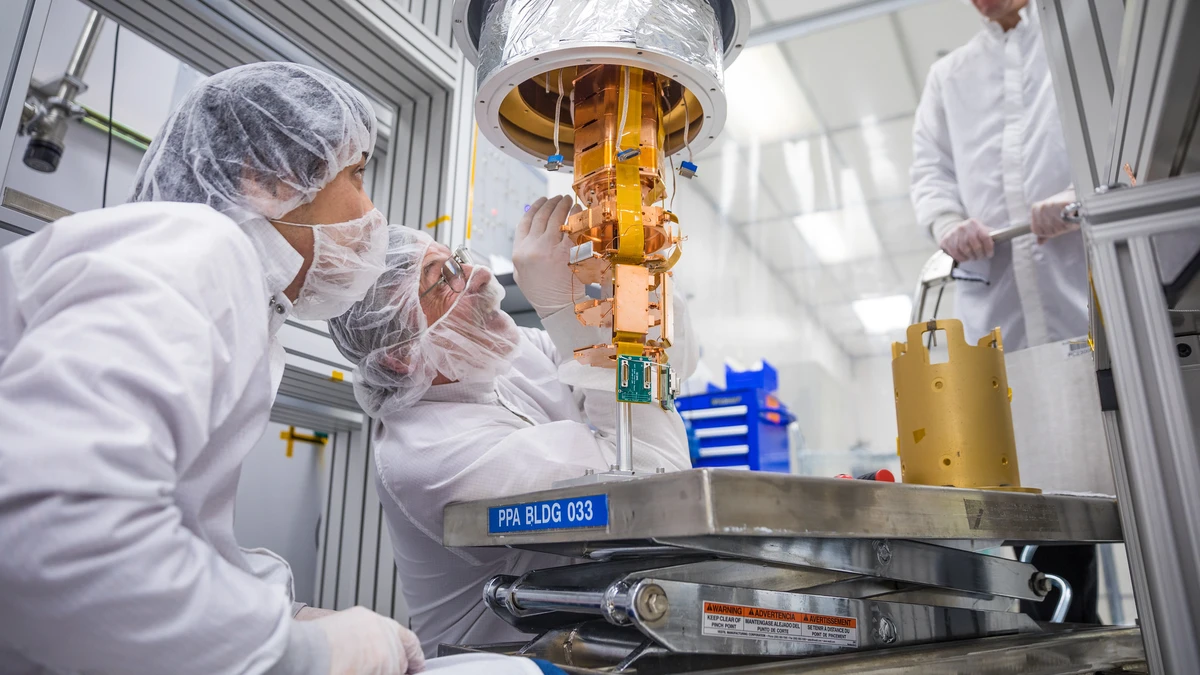
Zero Boil Off cryostats are those that contain liquid cryogens but are designed to eliminate or vastly reduce the boil off of the liquid. These cryostats combine some of the advantages of Cryogen-Free systems (e.g. ease of use and long operational lifetime) with the advantages associated with a reservoir of
liquid cryogens. Such a reservoir can provide a good isothermal heat sink, provide additional stability to superconducting magnets or serve as bulk liquid storage.
Zero Boil Off cryostats generally consist of systems that are designed to have very low heat leak coupled with a cryocooler designed to liquefy most or all of the vapor that boils off from the cryogen and return it to the reservoir. These cryostats are employed in situations where liquids are required but where refilling the liquid is difficult, impossible or very expensive.
A variety of cryogens can be used in Zero Boil Off cryostats. The storage of hydrogen and oxygen for use as propellants on long duration space missions is a particularly important application. D. Plachta reported on successful ground tests of a prototype system using nitrogen in 2004 (“Results of an Advanced Development Zero Boil-Off Cryogenic Propellant Storage Test”— NASA/TM—2004-213390).
?Solutions have also been found for liquid Xenon as part of a search for rare muon decays (“Development of a large volume zero boil-off liquid xenon storage system for muon rare decay experiment (MEG)”, Iwamoto et al., Cryogenics June 2009) and helium (“Vertical Access Zero Boiloff Rampable Superconducting Magnet System with Horizontal Field for Semiconductor Crystal Growth”, Jin et al., presented at the 2002 Applied Superconductivity Conference). Researchers at the Japanese Atomic Energy Research Institute have investigated the development of Free Electron Lasers for industrial use, driven by small superconducting RF systems that use zero boil off cryostats (“The JAERI Energy-Recovery Linac For Free-Electron Lasers” E. J. Minehara, Proceedings LINAC 2002)
While Zero Boil Off cryostats have many of the advantages of cryogen-free systems, they do still contain liquid cryogens and thus have to have properly designed pressure relief systems in case of cryocooler or cryostat failure.