ADVERTISEMENT

Ice to Fuel: NASA Tests Technology for Refueling Landers

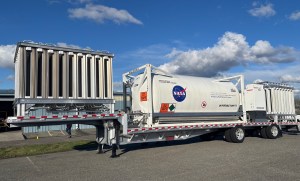
The farther the destination, the more fuel a rocket needs. The more fuel the rocket carries, the heavier the spacecraft. The heavier the spacecraft, the more fuel it requires to launch. Experts at NASA’s Glenn Research Center in Cleveland are testing technology that could solve this problem. The CryoFILL (Cryogenic...

zeroBOG™ Empowers Sustainable Operations

by Lennis Perez and Edward Tay, Sulzer The need for efficient and sustainable management of cryogenic gases extends far beyond traditional LNG applications. Enabling the recovery and reuse of boiloff gases, or BOG, across sectors such as hydrogen, e-methane and ammonia, supports the transition to low-carbon fuels and helps operators...

Liquid Air Comes of Age in Manchester

by Mark Vyvyan Robinson, Business Development Director, Highview Power As electricity systems integrate increasing volumes of renewable generation, the requirement for long-duration energy storage has become a defining challenge of the global energy transition. In northwest England, the city of Manchester and the surrounding Greater Manchester region are now home...

ADVERTISEMENT

Refrigerators and Liquefiers

Two of the most common terms used in cryogenics are “refrigerator” and “liquefier.” These terms describe similar and, as will be seen, in some cases identical components. A refrigerator provides cooling (that is, absorbs heat) at cryogenic temperatures. Refrigerators typically put a working fluid (such as helium) through one of...

Air Separation

Air separation is one of the largest, as well as earliest, industrial applications of cryogenics. In this process, cryogenic temperatures are used to separate air into its constituent gases: nitrogen (78.08%), oxygen (20.95%), argon (0.93%) and carbon dioxide (0.3%). Trace gases such as krypton, neon, xenon and helium total far...

Coefficient of Performance and Figure of Merit

The coefficient of performance (COP) is used to describe the effectiveness of refrigerators, including those operating at cryogenic temperatures. The COP is defined as the amount of heat removed at the cryogenic operating temperature of the refrigerator divided by the amount of work that must be applied to remove the...

Cryogenic Treatment of Materials

F.J. Diekman Controlled Thermal Processing, Inc. info@metal-wear.com Cryogenic Processing (also called cryogenic treatment, and incorrectly “cryogenic tempering”) is a process that uses cryogenic temperatures to modify materials to enhance their performance. Cryogenic Processing involves the slow reduction in temperature of the material to at least -300°F (-185°C) and holding the...

Cryogenics in Space

Peter Kittel University of California-Berkeley pkittel@cal.berkeley.edu Space Cryogenics is the application of cryogenics to space missions. These applications fall into two broad areas, supporting space science missions and supporting the space transportation infrastructure. Science applications: The atmosphere is opaque to much of the electro-magnetic spectrum. In space, the absence of...

Cryosurgery

Review of Cryosurgery Boris Rubinsky, PhD Hebrew University School of Science and Engineering Research Center for Biomedical Engineering 78b Ross Building Givat Ram, Jerusalem 91904 Israel rubinsky@cs.huji.ac.il as published in Annual Review of Biomedical Engineering, August 2000, Vol. 2, pp. 157-187. Abstract: Cryosurgery is a surgical technique that employs freezing...

Liquefied Natural Gas

Liquefied Natural Gas as it relates to the Field of Cryogenics John W. Bonn VJ Systems, LLC johnbonn@vjsystems-lic.com Today the world is looking for a cleaner fuel and Liquefied Natural Gas (LNG) plays a large part in achieving this goal. LNG in a liquid form is at -162°C (-259°F) and...

An Issue of Pressure and Flow Rate in a Supply Tank

Please help solve this problem: A supply tank requires a vaporizer to generate sufficient pressure to pump stored fluid up into a vehicle or tank. The available head is limited as the tank level falls and it is important to minimize the system pressure drop to maintain the desired flow...

Using MLI on VJ Line Joints or Cryo Storage Tanks

When installing Multi Layer Insulation (MLI) blankets on VJ line joints or cryo storage tanks should they be wrapped and tied down tight or loose? These are usually pre-cut to size. Also should they have an access hole at the point of where the molecular sieve is installed to help...