ADVERTISEMENT

Cryogenics in Zero Gravity

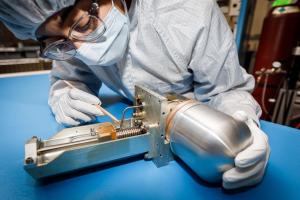
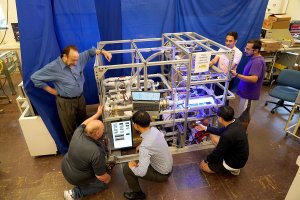
As we plan for future interplanetary spaceflight, one major aspect remains untested: refueling in space. That’s because most rocket propellants are cryogenic liquids whose long-term behavior in space is still unknown. Purdue University researchers are collaborating with NASA to study cryogenic liquids in zero gravity, leading to the possibility of...
Modified Pulse Tube Refrigerator Halves Cryogenic Cooling Time

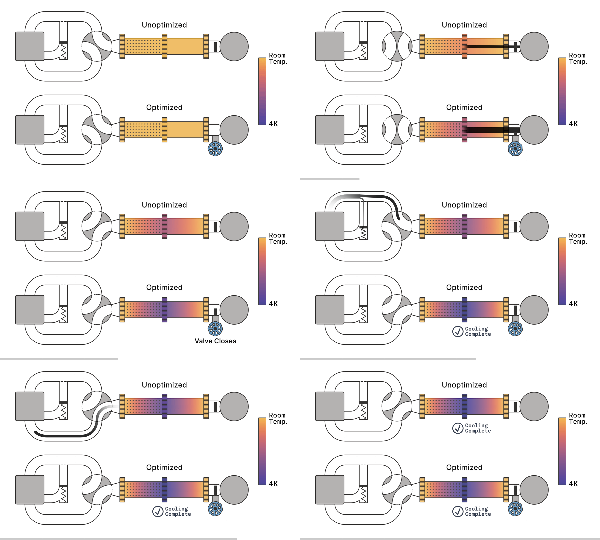
A simple modification to a popular type of cryogenic cooler could save $30 million in global electricity consumption and enough cooling water to fill 5000 Olympic swimming pools. That is the claim of researchers at the National Institute of Standards and Technology (NIST) and the University of Colorado Boulder who...

World’s Highest-Efficiency Hydrogen System Scales Up for Mass Production

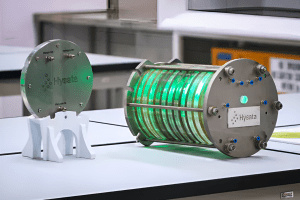
Hysata promises the world’s cheapest hydrogen, thanks to a remarkable device that splits water into H2 and O2 at 95% efficiency – some 20% higher than the best conventional electrolyzers. The company has raised US$111 million to scale up production.You have to throw some energy away to make hydrogen –...

Beyond Gravity Leaps Forward in Satellite Monitoring

Beyond Gravity, a leading space supplier, expands its expertise into space data services with the launch of its new Space Situational Awareness (SSA) solution. This innovative service, leveraging over six years of data collection, offers unparalleled accuracy and insights into more than 10,000 active satellites, promising to enhance faster decision-making...

CLARREO Pathfinder’s Cool Breakthrough, from Space to Quantum

For decades, Northrop Grumman has been making highly dependable cooling systems, cryocoolers, for spacecraft. In spacecraft, a cryocooler is most often essentially a specialized refrigerator deployed on satellites and space telescopes to maintain extremely low temperatures for onboard sensors. This is crucial for capturing high-resolution images of Earth or outer...

How CRYOCO Is Empowering the Next Generation

CRYOCO is at the forefront of cryogenic education, training and consulting, boasting a 45-year legacy of providing unparalleled expertise. With a focus on fostering technical prowess across various sectors, from aerospace to medical industries, the company has been instrumental in shaping the landscape of cryogenic applications. Led by David-John Roth,...

ADVERTISEMENT

Stability

Stability refers to the ability of a device employing superconductors to remain in its superconducting state after part of the superconductor transitions back to its normal conducting state due to a disturbance. While the concept can apply to many superconducting devices—transmission lines, generators, motors, etc.—it is most commonly considered in...

Cable-in-Conduit Conductors

Cable-in-Conduit Conductors (CICC) are a common form of superconducting cable used in large-scale applications. There are several varieties of CICCs, but they all consist of many small, stabilized superconducting wires contained within a conduit through which a coolant (typically supercritical He II) flows. Figure 1 shows the cross section of...

Bayonet Coupling

A bayonet coupling is a demountable joint that allows for quick and easy connection and disconnection of cryogenic components, including transfer lines, cryostats, liquefiers and refrigerators. Bayonets provide a number of advantages, chief among them the ability to connect and disconnect the bayonets while components they connect are still at...

Cryogenic Electronics

Randall Kirschman, consulting physicist, Mountain View, California ExtElect@gmail.com Cryogenic electronics—the operation of electronic devices, circuits, and systems at cryogenic temperatures—has been a valuable technology for decades. Cryogenic electronics (also referred to as low-temperature electronics, or cold electronics) can be based on semiconductive devices, on superconductive devices, or on a combination...

Particle Physics: High Energy Physics

Cryogenics and High-Energy Physics 1. From symmetry magazine: http://www.symmetrymagazine.org/cms/?pid=1000627: Cryogenics is the study of how materials behave at temperatures near absolute zero. In high-energy particle accelerators, such frigid temperatures reduce the electrical resistance of wires in superconducting magnets, increasing the magnet strength and allowing faster particle acceleration. The same holds...

HTS Degaussing Systems

From the Spring 2009 issue of Cold Facts (Volume 25, Number 2): Thanks to a joint project by the US Navy and a number of industry partners, high temperature superconducting (HTS) technology is now at the heart of an advanced degaussing system aboard the USS Higgins at the naval station...

Magnetic Resonance Imaging

From http://www.superconductors.org: An area where superconductors can perform a life-saving function is in the field of biomagnetism. Doctors need a non-invasive means of determining what’s going on inside the human body. By impinging a strong superconductor-derived magnetic field into the body, hydrogen atoms that exist in the body’s water and...

An Issue of Pressure and Flow Rate in a Supply Tank

Please help solve this problem: A supply tank requires a vaporizer to generate sufficient pressure to pump stored fluid up into a vehicle or tank. The available head is limited as the tank level falls and it is important to minimize the system pressure drop to maintain the desired flow...

Using MLI on VJ Line Joints or Cryo Storage Tanks

When installing Multi Layer Insulation (MLI) blankets on VJ line joints or cryo storage tanks should they be wrapped and tied down tight or loose? These are usually pre-cut to size. Also should they have an access hole at the point of where the molecular sieve is installed to help...