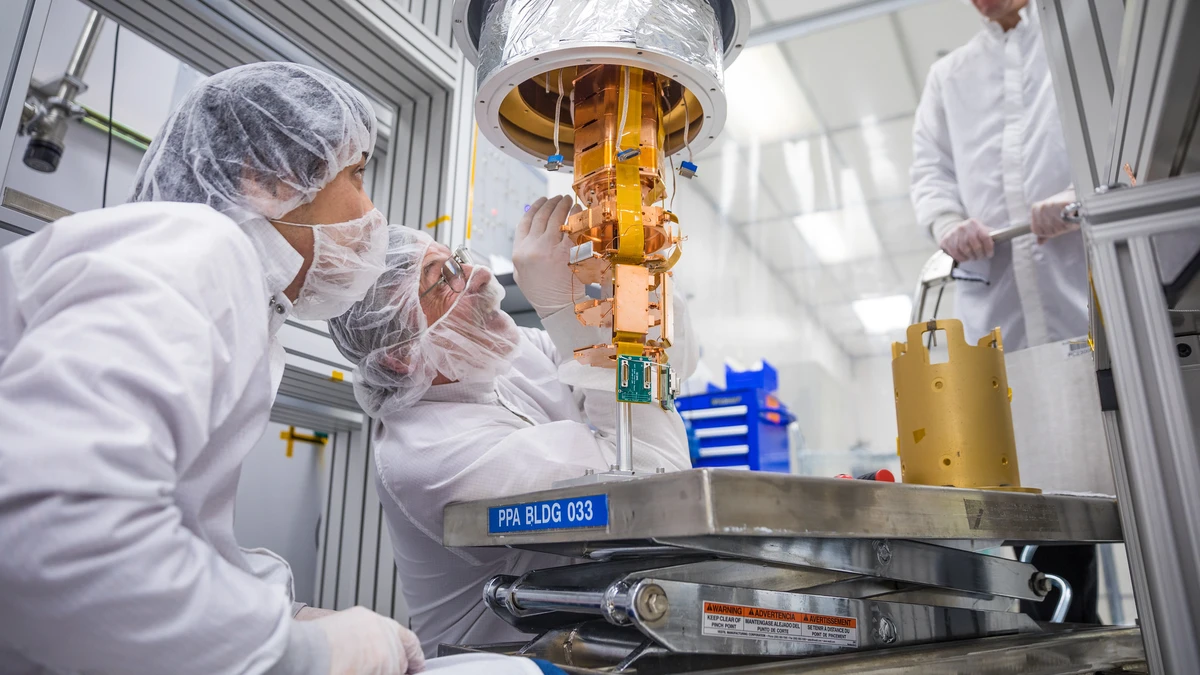
Cryogenics and High-Energy Physics
1. From symmetry magazine: http://www.symmetrymagazine.org/cms/?pid=1000627:
Cryogenics is the study of how materials behave at temperatures near absolute zero. In high-energy particle accelerators, such frigid temperatures reduce the electrical resistance of wires in superconducting magnets, increasing the magnet strength and allowing faster particle acceleration. The same holds true for superconducting cavities, cryomodules, and wires used in accelerators and detectors.
2. The Smithsonian/NASA Astrophysics Data System
http://adsabs.harvard.edu/abs/1997APS..PAC..8C04L
Cryogenics for Particle Accelerators: Present State-of-the-Art and Future Trends
Lebrun, Philippe
American Physical Society, Particle Acceleration Meeting, May 12-16, 1997, abstract #8C.04
Cryogenics has now become a key technology for particle accelerators and colliders, mostly as ancillary to superconductivity. On the high-energy frontier, superconducting magnets and RF cavities, operating at high fields, have permitted sustained progress in performance, while maintaining the size and cost of large research accelerators within the range of economic feasibility.
At the other end of the energy scale, cryogenics has enabled the construction of compact machines for industrial and medical applications, thus broadening the way for more widespread use of accelerators outside the physics laboratory. In all cases, the design and construction of cryogenic accelerators has spurred new developments in cryostats for beam components, thermal insulation techniques, helium distribution and refrigeration systems, instrumentation and process control, and quality assurance methods, the most significant of which are discussed through a review of recent and future projects.
3. Cryogenics for Particle Accelerators and Detectors (2002) (http://de.scientificcommons.org/783154)
Abstract: Cryogenics has become a key ancillary technology of particle accelerators and detectors, contributing to their sustained development over the last fifty years. Conversely, this development has produced new challenges and markets for cryogenics, resulting in a fruitful symbiotic relation which materialized in significant technology transfer and technical progress.
This began with the use of liquid hydrogen and deuterium in the targets and bubble chambers of the 1950s, 1960s and 1970s. It developed more recently with increasing amounts of liquefied noble gases – mainly argon, but also krypton and even today xenon – in calorimeters.
In parallel with these applications, the availability of practical type II superconductors from the early 1960s triggered the use of superconductivity in large spectrometer magnets – mostly driven by considerations of energy savings – and the corresponding development of helium cryogenics.
It is however the generalized application of superconductivity in particle accelerators – RF acceleration cavities and high-field bending and focusing magnets – which has led to the present expansion of cryogenics, with kilometer-long strings of helium-cooled devices, powerful and efficient refrigerators and superfluid helium used in high tonnage as cooling medium.This situation was well reflected over the last decades by the topical courses of the CERN Accelerator School (CAS).