In a recent Quantum Diaries blog, Laura Fields of Fermi National Accelerator Laboratory discusses this phenomenon. The MINERvA experiment is all about trying to understand what happens when neutrinos collide with ordinary matter. One thing we really want to understand is how neutrino interactions change depending on what kind of atomic nucleus is involved in the interaction. To study this, MINERvA has several layers of special materials — iron, lead and carbon – interspersed between the plastic layers that make up most of our detector.
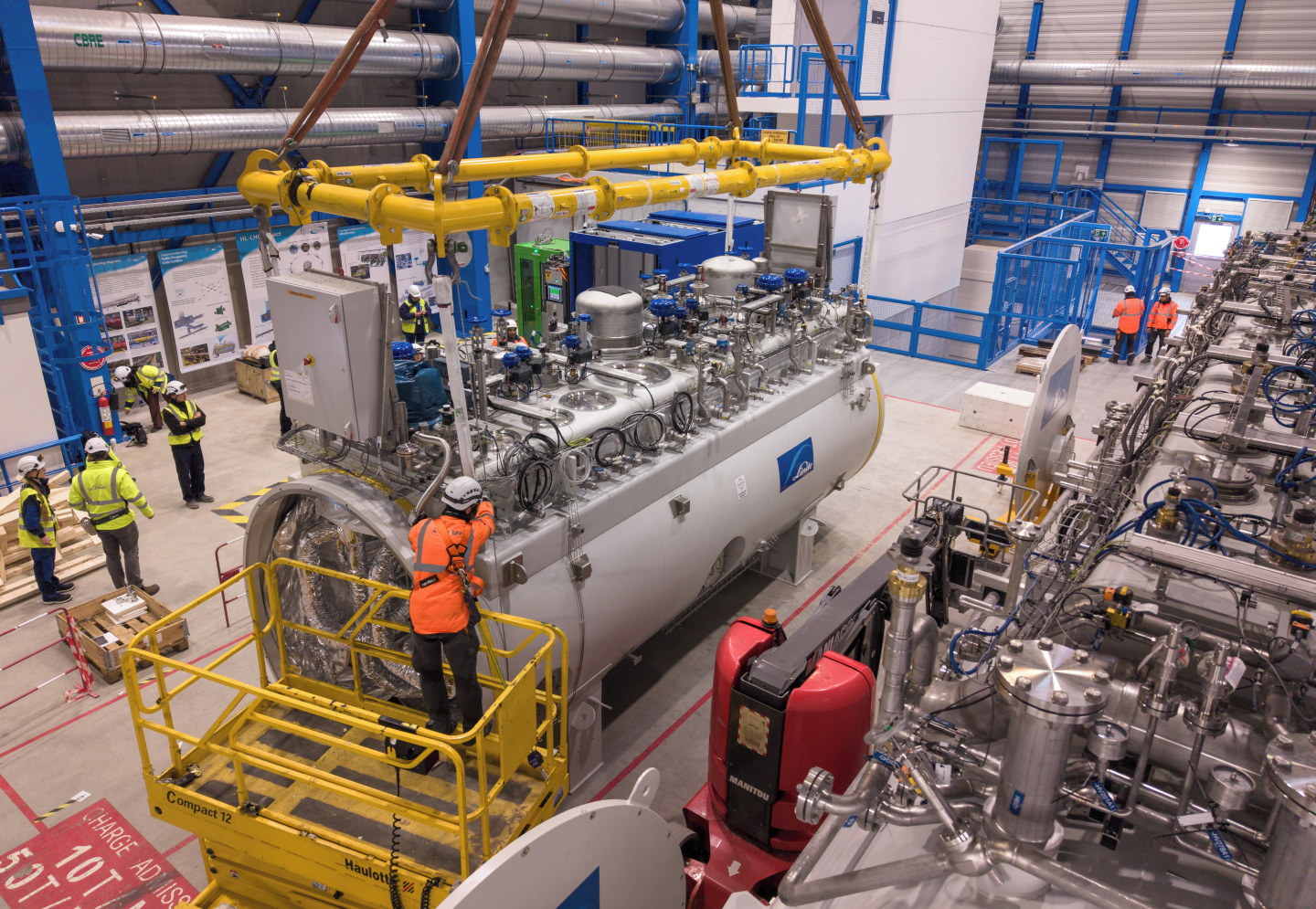
This past month, we got an exciting new target made of liquid helium. Designing and building the target was no small feat. The helium has to be kept ultra cold, and because MINERvA sits in an underground cavern, lots of care had to be taken so that people working in the cavern would be safe in the event of a gas leak.
Although helium is tricky from a logistical perspective, it’s very exciting from a scientific one. There aren’t many particles in a helium nucleus—only four protons and neutrons, compared to 56 for iron and over 200 for lead. This means that particles that result from neutrino interactions within helium nuclei are relatively unlikely to run into anything else on their way out of the nucleus. Comparing neutrino interactions in helium with the heavier target materials will help us untangle primary neutrino interactions from secondary interactions that can occur as the primary particles try to exit the nucleus.
The MINERvA collaboration is currently hard at work analyzing the data from our iron, lead and carbon detectors, and looking forward to analyzing the data from our helium target soon!