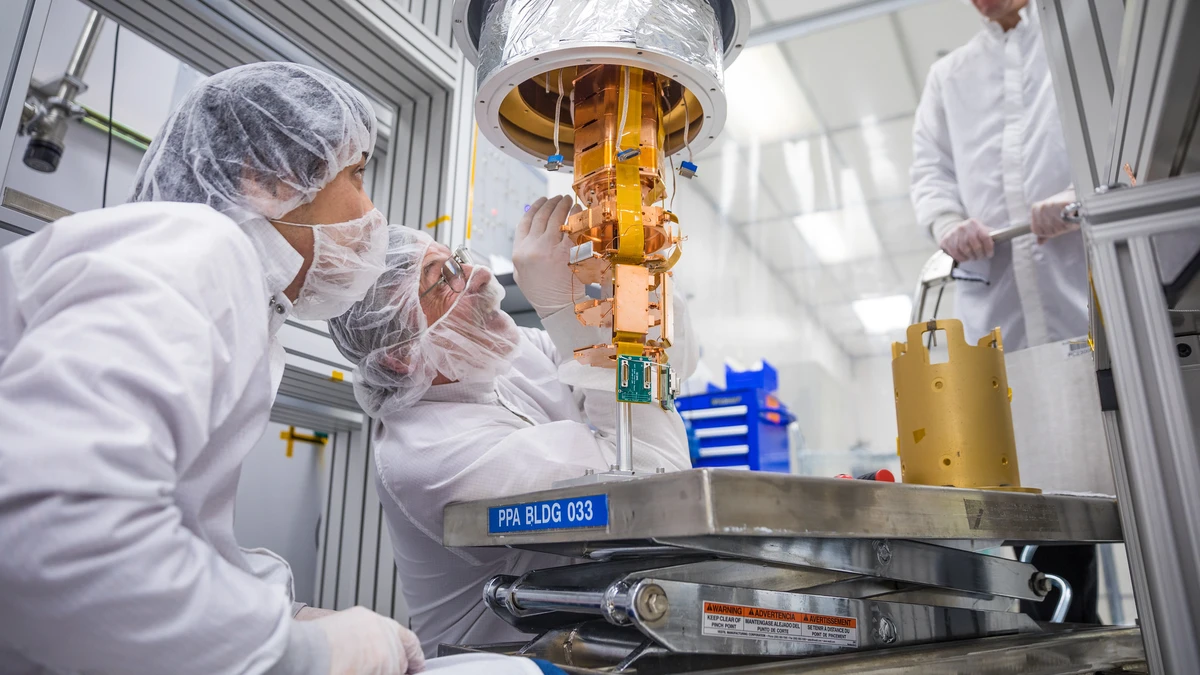
Dilution refrigerators are a common technique for reaching temperatures below 1K, particularly where continuous cooling at these temperatures is required. Helium exists in two stable isotopes: 4He and 3He. Naturally occurring 3He is extremely rare, constituting less than 1 part per million of helium gas. However, 3He can be manufactured, as it is a radioactive decay product of tritium (3H), an isotope of hydrogen. Almost all 3He used today is artificially produced. A dilution refrigerator uses a mixture of liquid 3He and liquid 4He and takes advantage of three physical attributes of these mixtures. These are:
1) Below 0.8K, the mixture will spontaneously separate into a 3He rich zone atop a heavier 4He rich zone.
2) Below 1K, the vapor pressure of 3He is much higher than that of 4He, thus pumping on the 4He rich zone will preferentially remove 3He atoms.
3) Energy is required to move a 3He atom from the 3He rich zone to the 4He rich zone. This has the effect of reducing the temperature of the mixture.
In its simplest form, then, a dilution refrigerator can be created by creating a bath (referred to as the mixing chamber) containing a mixture of 3He and 4He below 0.8K and then pumping on the 4He rich zone. This will preferentially remove 3He atoms. In order to maintain equilibrium, 3He atoms will move from the 3He rich zone to the 4He rich zone, causing the mixture and whatever is thermally attached to it to cool. Without any additional heat load, dilution refrigerators can reach a temperature of less than 10mK. More typically, dilution refrigerators remove 200 – 400 μW at 100mK.
While the theory is straightforward, practical dilution refrigerators are quite complicated, consisting of multiple heat exchangers, pumping systems and three to four liquid baths. Due to the expense of 3He, the refrigeration systems are designed to be closed cycle, constantly recirculating the 3He. This feature results in the dilution refrigerators providing continuous cooling, an advantage over other techniques such as Adiabatic De-magnetization Refrigerators (Cold Facts, Spring 2011). Given the low temperatures and small refrigeration capacities, dilution refrigerators must be built into very low heat leak cryostats.
A very good primer on dilution refrigerators, including a helpful animation, may be found at the website of the National High Magnetic Field Laboratory at Florida State University (http://www.magnet.fsu.edu/education/tutorials/tools/dilutionfridge.html).
Despite their complexity, reliable dilution refrigerators are in fact a commercial product and can be purchased as turnkey systems from vendors. See the CSA Buyer’s Guide for suppliers. Commercial dilution refrigerators are routinely used in research labs to provide sub-Kelvin temperatures for basic physics and materials studies. A dilution refrigerator is also a key component of the Cryogenic Dark Matter Search (CDMS) experiment currently underway in Soudan MN. Here, a commercial dilution refrigerator cools specialized Ge detectors down to 50mK in an effort to directly detect dark matter, believed to be a fundamental component of the universe.
Dilution refrigerators have also been used to cool sensors in space missions. A key feature of dilution refrigerators is the use of gravity to separate the heavier 4He rich region from the lighter 3He rich region in the mixing chamber. In space applications, the gravitational force is replaced by surface tension in small capillary tubes; see U. E. Israelsson, et al. “Dilution Refrigeration for Space Applications,” Cryogenics, Vol. 30, pp. 257–262 (1990).
The recently launched Planck Mission contains a dilution refrigerator providing 100 nW of cooling at 100mK. (S. Triqueneaux et al. “Design and Performance of the Dilution Cooler System for the Planck Mission,” Cryogenics, Vol. 46, pp. 288-297 (2006)). This device was an open-cycle system in which the helium was vented into space. Efforts are underway to design closed-cycle systems for future space applications. See, for example F. Martin, et al. “A Closed Cycle 3He-4He Dilution Refrigerator Insensitive to Gravity,” Cryogenics, Vol. 50, pp. 623-627 (2010).
Another trend in the development of dilution refrigerator systems is the replacement, where possible, of liquid baths with mechanical cryocoolers. Examples of this can be found in R. Schmitt et al., “Application of Cryocoolers to a Vintage Dilution Refrigerator” to be published in Adv. Cryo. Engr. Vol. 57 in 2012. And K. Uhlig et al. “3He/4He Dilution Refrigerator precooled by Gifford-McMahon Refrigerator, Cryogenics, Vol. 37, pp. 279 -282 (1997).
In recent years, supply of 3He has become an issue. In addition to its cryogenics use, 3He is a key component of neutron detectors used in homeland security applications. This increased use has resulted in higher costs and in some cases, shortages. Efforts are underway to find alternatives to 3He in neutron detection applications.