ADVERTISEMENT

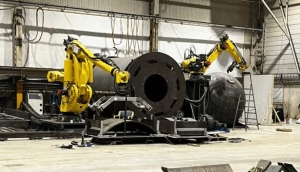
Working with substances at temperatures below negative 200 degrees the cryogenics team at NAWCAD Lakehurst specializes in servicing oxygen and nitrogen systems on aircraft, focusing on the storage and dispersal of liquid and gaseous nitrogen and oxygen. Credit: US Navy

NAWCAD Lakehurst enhances Cryogenic Systems for Naval Aviation

As the Cryogenics and Corrosion Control Support Equipment (SE) Integrated Product Team (IPT) Lead at NAWCAD Lakehurst, Asif Yeahia knows that many people may not fully understand the work his team does. However, working with substances at temperatures below negative 200 degrees gives them one of the “coolest” jobs at the...
Startup TAU systems has built a commercial laser-powered particle accelerator that fits in a single room. Credit: TAU Systems

Room-Size Particle Accelerators Go Commercial

By Charles Q. Choi Particle accelerators are usually huge structures—think of the 3.2-kilometer–long SLAC National Accelerator Laboratory in Stanford, Calif. But scientists have been hard at work trying to shrink these accelerators down by using lasers to perform the accelerating. These particle accelerators would be the size of single room, and cost much less as well. Now, a startup says...

Chinese Physicists Settle Einstein and Bohr’s Quantum Debate

A groundbreaking experiment recreates Einstein’s 1927 thought challenge, confirming fundamental quantum principle. In a landmark study that brings a definitive close to one of the most famous debates in modern physics, a team of Chinese scientists has experimentally validated Niels Bohr’s core quantum principle, demonstrating that a particle’s path and...

Twisted Stacks of 2-D Carbon Act Like a Weird Type of Superconductor

“Magic-angle” graphene could help solve the puzzle of how unconventional superconductors work By Emily Conover Stacks of graphene, carefully twisted, gain a superpower: They become superconductors. Now scientists have new evidence that this “magic-angle” graphene is a member of a truly strange class of superconductor. Like all superconductors, the materials, known...
Images--Left: Current input terminal (100A compatible, size: outermost metal diameter Φ16mm x length 94mm) Right: MS-8 pin terminal (Maximum 110A, size: metal outer diameter Φ41mm x length 72.5mm)

World-First High-Current Terminals for Liquid Hydrogen

Kyocera Corporation (President and CEO: Hideo Tanimoto, hereinafter referred to as “Kyocera”) is pleased to announce that, through joint research with the Japan Aerospace Exploration Agency (hereinafter referred to as “JAXA”), it has developed two new products: a 100A current feedthrough terminal that ensures durability and airtightness in liquid hydrogen...

Making a Splash on Cryogenic Surfaces

Cryogenic surfaces do not hinder droplet splashing, but smaller droplets make smaller splashes. Hannah Richter On a rainy day, a classic physical property is on display: droplet splashing. How liquids splash is not just important for keeping one’s clothes dry, but for applications from inkjet printing to spraying crops to...

ADVERTISEMENT

Dewar

A dewar is a type of cryostat named after Sir James Dewar, the researcher who first developed the concept of a vacuum insulated container with silvered walls to reflect thermal radiation. Dewar was the first to liquefy hydrogen, and he created the device to store his discovery. The thermos bottle...

Stirling and Gifford-McMahon Cryocoolers

Stirling and Gifford-McMahon (GM) cryocoolers are two of the most commonly used cryocoolers in cryogenics. Both devices have a significant industrial base and operate at a wide range of temperatures and capacities. The thermodynamic cycles for both of these cryocoolers are quite similar. The Stirling cycle consists of a compressor,...

Liquefied Natural Gas (LNG)

A significant commercial application of cryogenics is the liquefaction, transport and storage of natural gas. Liquefied Natural Gas (LNG) is generally 95 percent methane with a few percent ethane and much lower concentrations of propane and butane. LNG liquefies at 111.6 K. Unlike many applications of cryogenics, the motivation for...

Cryogenic Treatment of Materials

F.J. Diekman Controlled Thermal Processing, Inc. info@metal-wear.com Cryogenic Processing (also called cryogenic treatment, and incorrectly “cryogenic tempering”) is a process that uses cryogenic temperatures to modify materials to enhance their performance. Cryogenic Processing involves the slow reduction in temperature of the material to at least -300°F (-185°C) and holding the...

Cryogenics in Space

Peter Kittel University of California-Berkeley pkittel@cal.berkeley.edu Space Cryogenics is the application of cryogenics to space missions. These applications fall into two broad areas, supporting space science missions and supporting the space transportation infrastructure. Science applications: The atmosphere is opaque to much of the electro-magnetic spectrum. In space, the absence of...

Cryosurgery

Review of Cryosurgery Boris Rubinsky, PhD Hebrew University School of Science and Engineering Research Center for Biomedical Engineering 78b Ross Building Givat Ram, Jerusalem 91904 Israel rubinsky@cs.huji.ac.il as published in Annual Review of Biomedical Engineering, August 2000, Vol. 2, pp. 157-187. Abstract: Cryosurgery is a surgical technique that employs freezing...

Liquefied Natural Gas

Liquefied Natural Gas as it relates to the Field of Cryogenics John W. Bonn VJ Systems, LLC johnbonn@vjsystems-lic.com Today the world is looking for a cleaner fuel and Liquefied Natural Gas (LNG) plays a large part in achieving this goal. LNG in a liquid form is at -162°C (-259°F) and...