ADVERTISEMENT

New Superconductor Could Lead to Quantum Computing Breakthrough

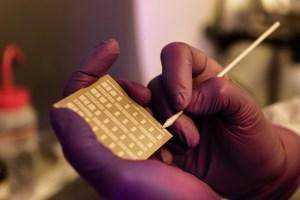
Superconductivity is the property of zero electrical resistance at ultralow temperatures and was discovered in 1911 by the Dutch physicist Kamerling-Ohnes. It plays a crucial role in many industries and technologies, ranging from quantum computing to energy. “Superconductors are amazing materials which have many strange and unusual properties,” explained Joe Carroll,...

Cryogenic SRAM IP Demonstrator Taped Out

sureCore’s cryogenic SRAM is a building block for any digital sub-system, that is capable of operating from 77K (-196° C) down to the near absolute zero temperatures needed by Quantum Computers (QCs).  Standard cell and IO cell libraries have been re-characterized for operation at cryogenic temperatures, thereby enabling an industry...

New Bolometer Could Lead to Better Cryogenic Quantum Technologies

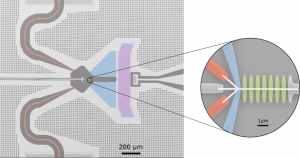
A new type of bolometer that covers a broad range of microwave frequencies has been created by researchers in Finland. The work builds on previous research by the team, and the new technique could potentially characterize background noise sources and thereby help to improve the cryogenic environments necessary for quantum...

Air Gases Can Benefit the Environment

Overview-The commercial production of oxygen and nitrogen supported the industrial revolution in the late 19th century and up to the mid-20th. Oxy-acetylene cutting and welding were important for projects like the Eiffel Tower, the Panama Canal and the Central Valley Project Corporation hydropower plants. Oxygen, nitrogen and argon refined steelmaking...

Analyzing Transcritical CO2 Compression and Pumping Pathways

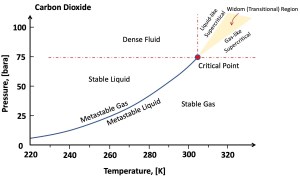
Supercritical carbon dioxide exhibits anomalous behavior in the vicinity above the critical point. The Irish physical chemist Thomas Andrews (1863) was the first who studied the supercritical behavior of carbon dioxide. He explained his observations of the fluid state above the critical point as follows: “…the surface of demarcation between the...

ADVERTISEMENT

Adiabatic Demagnetization Refrigeration

Reaching temperatures below 1K requires different techniques than the various helium gas cycles found in large scale refrigeration plants and small cryocoolers. One of these techniques is Adiabatic Demagnetization Refrigeration (ADR). This technique takes advantage of the fact that the entropy of paramagnetic materials in a magnetic field is lower than...

Cryogen-Free

A cryogen is any fluid that operates at cryogenic temperatures (below roughly 150K – 120K). Using this definition, helium gas at 40K is a cryogen. Another more restrictive definition is to use cryogen to refer specifically to liquids at cryogenic temperatures. This is generally how it is used in the...

Cryostats and Cryocoolers

A cryostat is any device designed to maintain things (including fluids) at cryogenic temperatures. In general usage, cryostats tend to be passive devices rather than providing active cooling. In this usage, cryostats keep things cold by thermally isolating them from room temperature. This generally is accomplished by a combination of...

Air Separation and Liquefaction

by Nils Tellier, PE, President, EPSIM Corporation (CSA CSM) nils@epsim.us All illustrations courtesy EPSIM Corporation Background History of Air Separation and Liquefaction This section builds on a rich history of methods to develop deep refrigeration and cryogenic liquefaction during the 19th Century. You are encouraged to read Cryo Central’s History...

Bose-Einstein Condensate

A Bose-Einstein condensate, first proposed in 1925 by Albert Einstein based on work done by Satyendra Nath Bose (the same Bose from whom the term boson is derived), is a super-cold state of matter in which almost all of the individual atoms have “condensed” down to the lowest possible quantum...

Cold Technology for Pest Control

While it does not reach temperatures cold enough to be called cryogenic, carbon dioxide snow is at the heart of a new way of dealing with unwanted pests. It utilizes a quick freezing process that takes advantage of the properties of carbon dioxide snow and has a number of benefits...

Cryogenic Finishing

The following 3 articles discuss the uses and procedures of various type of cryogenic finishing. 1) By Robin A. Rhodes, Cryogenic Institute of New England, Inc. rrhodes@nitrofreeze.com Cryogenic Deflashing is employed to remove undesired residual mold flash that remains on molded parts after they are removed or ejected from the...

Getter materials to absorb out gassed materials?

Here’s one for the scientists: We would like to sell vacuum insulated pipe for high temperature fluid applications. Are there any good getter materials that we can place in the vacuum space of our VJP to absorb outgassed materials at elevated temperatures?