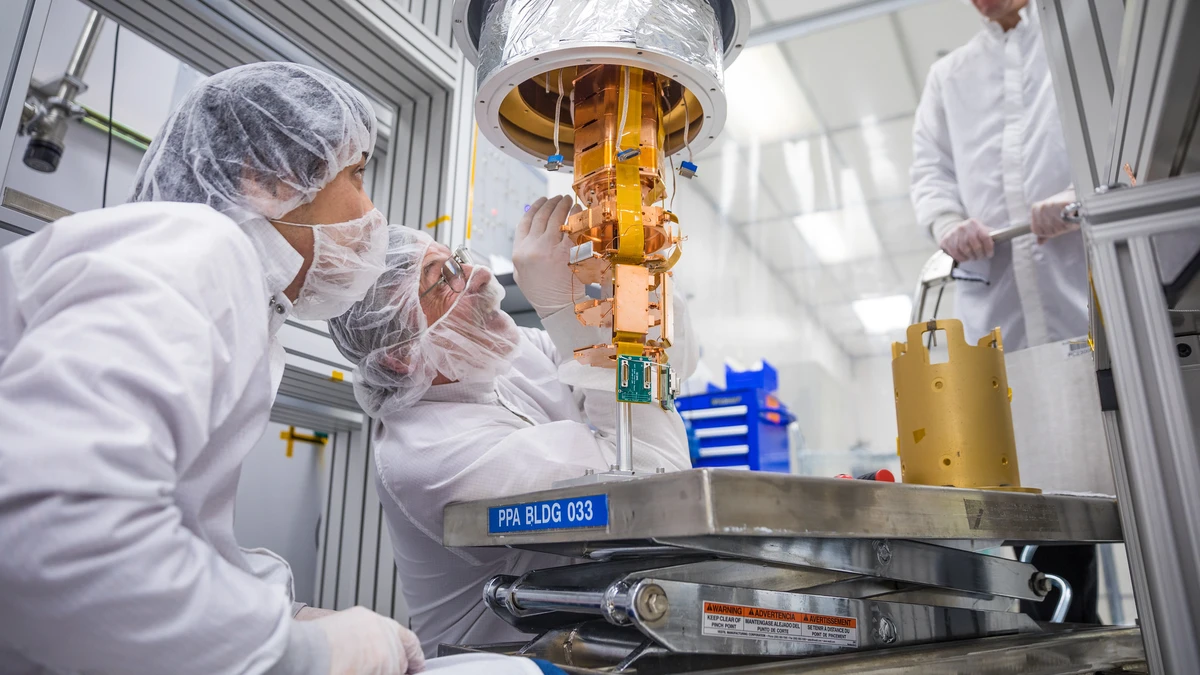
Reaching temperatures below 1K requires different techniques than the various helium gas cycles found in large scale refrigeration plants and small cryocoolers. One of these techniques is Adiabatic Demagnetization Refrigeration (ADR). This technique takes advantage of the fact that the entropy of paramagnetic materials in a magnetic field is lower than when no field is present. The lower entropy comes from the magnetic regions in the paramagnetic material being aligned and thus more ordered in the presence of a magnetic field. A more ordered solid has lower entropy.
In effect, the ADR transfers entropy between the random thermal vibrations of the paramagnetic material and the alignment of the magnetic regions. Consider an adiabatic (thermally isolated) sample. When the magnetic field is raised, the magnetic regions align and release entropy into the thermal vibrations heating the material. When the magnetic field is reduced, the regions drop out of alignment and absorb entropy from the thermal vibrations cooling the material.
A simple example of an ADR system consists of a paramagnetic solid connected to the object to be cooled and via a thermal switch to a heat sink. The ADR system is cyclic. In the first part of the cycle, the paramagnetic solid is thermally isolated and a magnetic field is applied to the solid. As the field is increased, the magnetic regions in the solid start to align and the paramagnetic solid heats up.
Next, the thermal switch is connected and heat is transferred from the solid to the heat sink while the magnetic field is held constant. This reduces the temperature of the solid, back to near its starting point. The thermal switch is now closed, isolating the solid and the magnetic field is now reduced. This is the adiabatic demagnetization portion of the cycle. As the magnetic field is reduced the paramagnetic regions become more disordered and absorb entropy from the thermal vibrations resulting in a cooling of the paramagnetic material and of the object being cooled.
In typical applications, the heat sink is a liquid helium bath and the ADR reaches temperatures down to the mK level. As cyclic devices, ADRs typically can be built to hold the object being cooled to mK temperatures for up to several days. After this time, the system is recycled with the temperature being raised up to near that of the heat sink before the cycle is repeated. ADR systems that provide continuous cooling, generally by using more than one ADR operating in tandem, have also been developed.
There is, of course, a lot of detailed design work required for successful ADRs. This includes proper selection of the paramagnetic solid; Gadolinium-Gallium Garnet (GGG) or Ferric Ammonium Alum (FAA) are typical examples; and proper design of both the superconducting magnet and thermal switch.
Commercially produced ADR systems can be purchased for laboratory work. Custom made ADRs are frequently used in space applications as they reduce the need for zero gravity fluid management at these temperatures. Examples of custom ADR systems are given in “Optimization of a Two-stage ADR for the Soft X-Ray Spectrometer (SXS) on the Astro-H Mission”, P.J. Shirron et al., “300 mK Continuous Cooling, Sorption-ADR System”, J.M. Duval et al. both in Adv. Cryo. Engr. Vol. 55 (2010) and “Design of a Continuous ADR for the ESA Mission XEUS Based on the ESA Engineering Model ADR”, J. Bartlett et al. Proceedings of ICEC 21 (2007).