ADVERTISEMENT

Solving a Mystery in Dark Matter Detectors Could Improve Quantum Computers

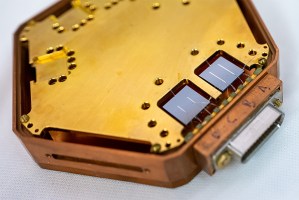
By Lauren Biron Although dark matter makes up most of the mass in our universe, it has never been directly observed. To hunt for lighter dark matter and other rare phenomena, researchers must solve a puzzle in their supersensitive detectors: an unexpected number of low-energy events, called the “low-energy excess”...

Hydrogen Aviation Advances With Airbus and RWTH Aachen’s GENtwoPRO Fuel Cell Project

By Erin Kilgore If you’ve been tracking the future of hydrogen aviation, you know it’s a path packed with big ideas and tricky engineering puzzles. Now, Airbus and RWTH Aachen University have kicked off an Airbus RWTH Aachen partnership laser-focused on a near-term, high-impact goal: using scalable fuel cell technology to power regional aircraft. Early in Airbus’s hydrogen journey,...

ADVERTISEMENT

Adiabatic Demagnetization Refrigeration

Reaching temperatures below 1K requires different techniques than the various helium gas cycles found in large scale refrigeration plants and small cryocoolers. One of these techniques is Adiabatic Demagnetization Refrigeration (ADR). This technique takes advantage of the fact that the entropy of paramagnetic materials in a magnetic field is lower than...

Cryogen-Free

A cryogen is any fluid that operates at cryogenic temperatures (below roughly 150K – 120K). Using this definition, helium gas at 40K is a cryogen. Another more restrictive definition is to use cryogen to refer specifically to liquids at cryogenic temperatures. This is generally how it is used in the...

Cryostats and Cryocoolers

A cryostat is any device designed to maintain things (including fluids) at cryogenic temperatures. In general usage, cryostats tend to be passive devices rather than providing active cooling. In this usage, cryostats keep things cold by thermally isolating them from room temperature. This generally is accomplished by a combination of...

Cryogenic Treatment of Materials

F.J. Diekman Controlled Thermal Processing, Inc. info@metal-wear.com Cryogenic Processing (also called cryogenic treatment, and incorrectly “cryogenic tempering”) is a process that uses cryogenic temperatures to modify materials to enhance their performance. Cryogenic Processing involves the slow reduction in temperature of the material to at least -300°F (-185°C) and holding the...

Cryogenics in Space

Peter Kittel University of California-Berkeley pkittel@cal.berkeley.edu Space Cryogenics is the application of cryogenics to space missions. These applications fall into two broad areas, supporting space science missions and supporting the space transportation infrastructure. Science applications: The atmosphere is opaque to much of the electro-magnetic spectrum. In space, the absence of...

Cryosurgery

Review of Cryosurgery Boris Rubinsky, PhD Hebrew University School of Science and Engineering Research Center for Biomedical Engineering 78b Ross Building Givat Ram, Jerusalem 91904 Israel rubinsky@cs.huji.ac.il as published in Annual Review of Biomedical Engineering, August 2000, Vol. 2, pp. 157-187. Abstract: Cryosurgery is a surgical technique that employs freezing...

Liquefied Natural Gas

Liquefied Natural Gas as it relates to the Field of Cryogenics John W. Bonn VJ Systems, LLC johnbonn@vjsystems-lic.com Today the world is looking for a cleaner fuel and Liquefied Natural Gas (LNG) plays a large part in achieving this goal. LNG in a liquid form is at -162°C (-259°F) and...

Thermal conductivity of niobium, tantalum, lead, tin

I am interested in the thermal conductivity and other properties of low temperature superconductors. Specifically I am interested in materials like Niobium, Tantalum, Lead and Tin. Would you know of a publication that dealt with thermal properties in general and also gave specific data on these materials?