Peter Kittel
University of California-Berkeley
pkittel@cal.berkeley.edu
Space Cryogenics is the application of cryogenics to space missions. These applications fall into two broad areas, supporting space science missions and supporting the space transportation infrastructure.
Science applications: The atmosphere is opaque to much of the electro-magnetic spectrum. In space, the absence of an atmosphere has been a great boon to doing astronomy at these wavelengths. Being in space has enabled Earth and atmospheric science missions to gather global data. Many of these science missions use infrared, gamma ray, and x-ray detectors that operate at cryogenic temperatures. The detectors are cooled to increase their sensitivity. Astronomy missions often use cryogenic telescopes to reduce the thermal emissions of the telescope, permitting very faint objects to be seen. A broad range of cryogenic technology is needed to support these missions. For instance, materials change their properties (strength, dimensions, thermal, electrical, magnetic, and optical properties all change). These changes need to be considered when building an instrument for space. It is a challenge to design a telescope that is assembled at room temperature and then cooled to 20 kelvin (-253°C) or so and launched into space. After surviving the high vibration environment of launch and the dimensional changes of cooling down, the instrument must be in focus and provide an undistorted image. All of this, while being well insulated and having very low mass.
Then there is the matter of how to cool the instrument. Radiators (blackened surfaces shielded from the Sun and Earth) can cool instruments to the 100 kelvin (-173°C) range in Earth orbit. In orbits far from the Earth (such Spitzer uses) 30k (-243°C) can be reached. For lower temperatures, instruments have used stored solid cryogens (such as nitrogen, neon, or hydrogen). Solid hydrogen will work for requirements down to 6 kelvin (-267°C). For lower temperatures, liquid helium can be used in the 1-2 kelvin range. Containing liquids while venting the effluent vapor has been a challenge. The disadvantage of using a stored cryogen is that it is converted to vapor by heat dissipated in the instrument or that comes in through the supports and insulation. Eventually, the cryogen is consumed, ending the mission. Recently there have been many advances in building closed cycle refrigerators for space applications. These coolers have extended mission durations and extended the range of temperatures available to 0.05 kelvin. These coolers are required to be long lived, 5-10 years, have a very low system mass (including the mass of solar cells and electronics to power the coolers and radiators to reject heat) and, often, have very low vibration.
Another area of space science, which makes use of cryogenics, is sample preservation. This includes the preservation of biological samples from experiments on the Shuttle and the Station and the preservation of material gathered from comets, asteroids, and other planets. These applications have used phase change materials (solid to liquid transition) or liquid nitrogen absorbed in fine pore as coolants. Closed cycle coolers are now being developed for these applications.
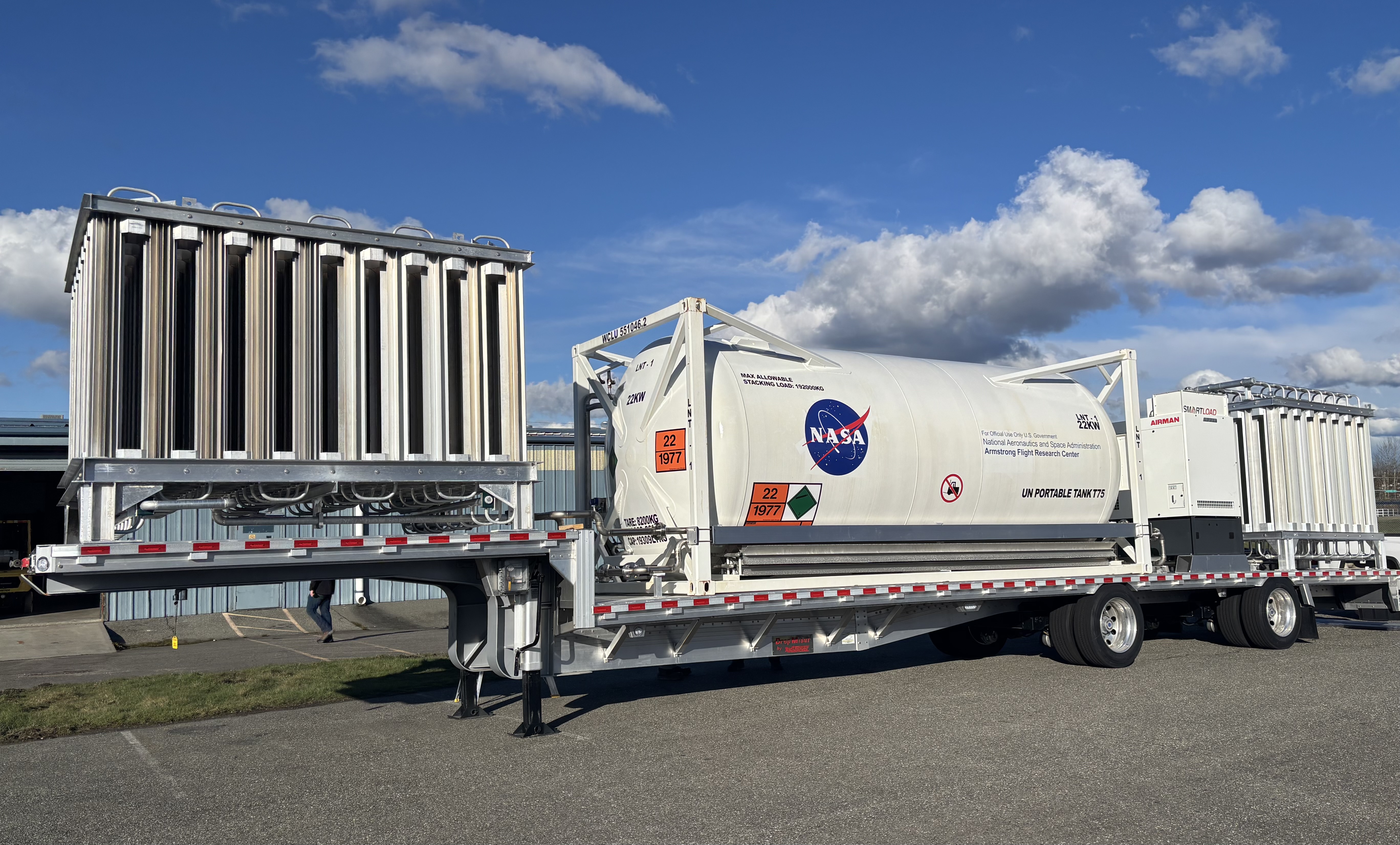
Space transportation: Liquid hydrogen and liquid oxygen are used in the main engines of the Shuttle because they offer a very high specific impulse (thrust per unit mass of propellant consumed). These propellants are cryogenic with normal boiling points of 20 kelvin (-253°C) and 90 kelvin (-183°C) respectively. For the Shuttle, these propellants are stored in the poorly insulated external tank. There is interest in extending the storage time of cryogenic propellants from a few hours to many years and in being able to resupply rockets with these propellants from depots in space. While, in principle, this can be achieved, the techniques discussed above, the size of transportation systems, many tons of propellants, require new engineering approaches.