As renewable energy, electrification and advanced research technologies continue to expand, the demands placed on wire and cable systems are evolving just as rapidly. Higher power densities, tighter system integration and increasingly extreme operating environments are pushing manufacturers beyond traditional commodity wire solutions.
Caleb Lemmons, Business Development Manager at Pelican Wire, says these shifts are redefining performance expectations across the industry. “Renewable energy and electrification are driving wire and cable designs to new levels of performance and durability,” Lemmons explains. “As power systems become more distributed and power-dense, there is a greater need for solutions that can handle higher currents, voltages and switching frequencies.”
These changes place greater emphasis on thermal management, dielectric performance and electromagnetic interference control. At the same time, many of these systems are being deployed in environments that challenge conventional materials. From offshore wind installations and desert solar fields to industrial facilities and arctic conditions, wire and cables must maintain reliability under constant environmental stress.
Cryogenic Conditions Create Unique Design Challenges

Cryogenic environments present some of the most demanding conditions for wire performance. At extremely low temperatures, many common insulation materials become brittle, increasing the likelihood of damage during bending, vibration or repeated motion. Lemmons notes that thermal cycling compounds these risks.
“The difference in thermal contraction rates between conductors, insulation and shielding can create mechanical stress during temperature transitions,” he says. “Over time, that stress can lead to gradual degradation or failure.”
Electrical performance can also be affected. Properties such as dielectric constant and insulation resistance may shift at cryogenic temperatures, which is especially critical for high-voltage applications and sensitive signal transmission. Mechanical factors like flex life and termination reliability must also be carefully addressed to ensure long-term system integrity.
A Systems-Based Approach to Wire Design
Pelican Wire addresses these challenges through a systems-based design philosophy focused on application-specific performance rather than off-the-shelf solutions. According to Lemmons, the process begins with a detailed understanding of each application’s operating conditions.
“We evaluate temperature range, environmental exposure, voltage and current requirements and mechanical stresses,” he says. “That information guides material selection and overall construction.”
Specialized fluoropolymers and other high performance materials are commonly used for cryogenic applications due to their low-temperature flexibility and compatible thermal contraction behavior. Conductors and shielding configurations are selected to balance electrical performance with mechanical durability and environmental resistance.
To validate reliability, Pelican Wire subjects designs to rigorous testing that reflects real-world conditions. Thermal cycling and low-temperature flexibility testing help ensure that wire assemblies will perform consistently over time, not just during initial deployment.
Growing Demand Across Energy and Research Applications
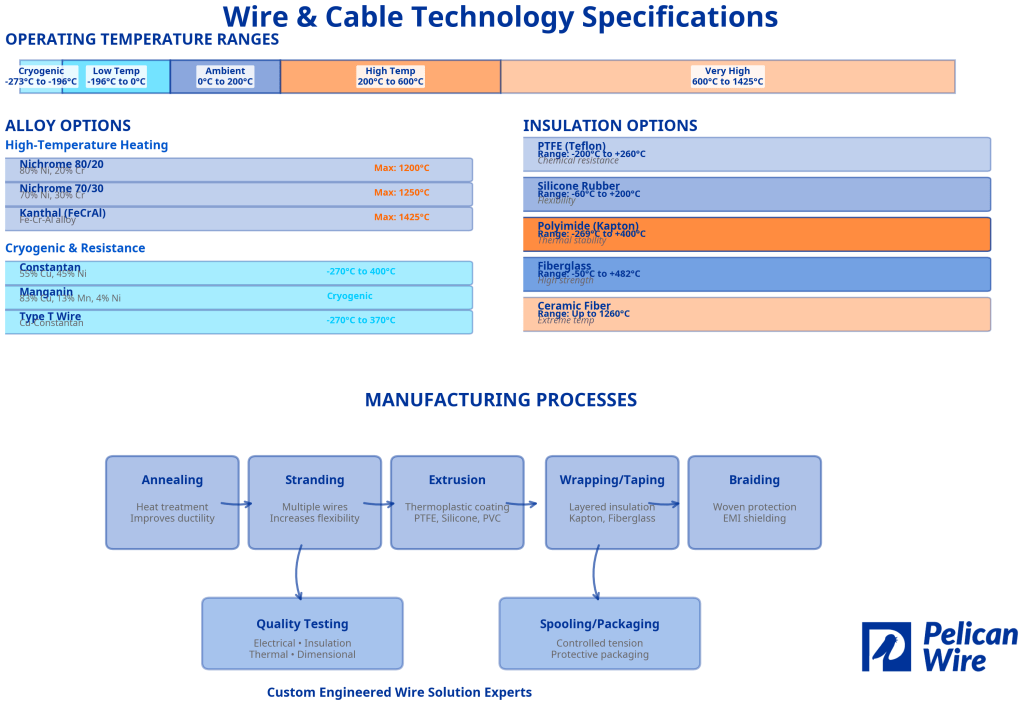
Demand for wire solutions capable of operating in both ambient and cryogenic conditions is increasing across several sectors. Hydrogen infrastructure is one of the most prominent examples. Systems for hydrogen liquefaction, storage and transfer must function reliably as temperatures shift between ambient and cryogenic states.
“The expansion of hydrogen infrastructure is driving the need for wire that can handle repeated transitions without compromising electrical or mechanical performance,” Lemmons says.
Advanced industrial gas handling systems also contribute to this demand, such as aerospace platforms, research environments and advanced computing systems that support electrification initiatives. In many of these applications, system uptime is critical and wire failure can lead to costly downtime or safety concerns.
Looking Ahead at Extreme Energy Systems
As energy systems continue to evolve, Lemmons expects wire and cable design to become even more specialized. Increasing power density, tighter packaging and higher switching frequencies will require enhanced thermal performance, stronger dielectric properties and improved electromagnetic compatibility.
“There is also a growing emphasis on long-term reliability and uptime, especially for critical infrastructure,” he says. “That puts more focus on engineered material systems and construction techniques that reduce the risk of failure at interfaces.”
Those interfaces, particularly between insulation, shielding and conductors, are often the most vulnerable points in extreme temperature environments. Addressing them requires a combination of materials expertise, application knowledge and disciplined manufacturing processes.
Ultimately, Lemmons believes success in this market depends on the ability to align design, materials and manufacturing with the realities of modern energy systems. “The ability to combine materials expertise with application-driven design and consistent, high-quality manufacturing will be essential,” he says.
As cryogenic and electrified technologies continue to expand, Pelican Wire’s approach highlights how thoughtful engineering at the cable level plays a critical role in enabling the next generation of energy and research systems. http://www.pelicanwire.com