ADVERTISEMENT

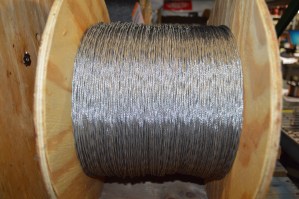
ALLVAR Alloy 30 expands when cooled, the opposite of invar and aluminum, and maintains negative thermal properties at cryogenic temperatures. Credit: Allvar

ALLVAR Alloys Solve Cryogenic Mismatch

ALLVAR Alloy 30 expands when cooled, the opposite of invar and aluminum, and maintains negative thermal properties at cryogenic temperatures. Credit: Allvar by James A. Monroe, Ph.D., ALLVAR Almost all materials expand when heated and contract when cooled, known as positive thermal expansion. Some materials expand and contract a lot...
Ice Cure medical Logo

IceCure Receives Notice of Patent Allowance in China for a Novel Cryogen Flow Control to Optimize Patient Cryoablation Outcomes

IceCure Medical Ltd., developer of minimally invasive cryoablation technology that destroys tumors by freezing them, announced that it has received a Notice of Allowance from the China National Intellectual Property Administration (CNIPA) for a new patent titled “Cryogen Flow Control.” The patent relates to IceCure’s next-generation XSense™ cryoablation system and...
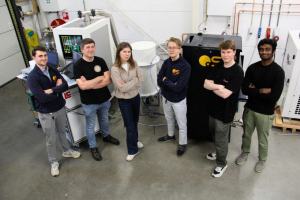
Professor Stefanie Gutschmidt, Head of UC’s Department of Mechanical Engineering, and UC Principal Researcher Dr Alan Caughley run the cyrocooler technology in the new CryoLab. Credit: UC Canterberry

UC Launches New Lab to Advance Cryogenics Research

University of Canterbury News The University of Canterbury (UC) has launched a new lab dedicated to cryogenics research and consultancy. CryoLab is now Aotearoa New Zealand’s only cryogenics research group combining advanced cryogenic refrigeration research with consulting to industry in cryogenics, fluid mechanics, and thermodynamics. Cryogenics is the science of...
Quantum Design Acquires Oxford NanoScience, Joining Two Historic Cryogenic Companies

Quantum Design Acquires Oxford NanoScience, Joining Two Historic Cryogenic Companies

Quantum Design (QD) is pleased to announce the completion of the acquisition of the Oxford NanoScience division of Oxford Instruments. This acquisition unites two industry leaders with a combined legacy of more than 100 years of experience and innovation in cryogenics, materials science, and microscopy. The expanded, shared product catalog...
Working with substances at temperatures below negative 200 degrees the cryogenics team at NAWCAD Lakehurst specializes in servicing oxygen and nitrogen systems on aircraft, focusing on the storage and dispersal of liquid and gaseous nitrogen and oxygen. Credit: US Navy

NAWCAD Lakehurst enhances Cryogenic Systems for Naval Aviation

As the Cryogenics and Corrosion Control Support Equipment (SE) Integrated Product Team (IPT) Lead at NAWCAD Lakehurst, Asif Yeahia knows that many people may not fully understand the work his team does. However, working with substances at temperatures below negative 200 degrees gives them one of the “coolest” jobs at the...
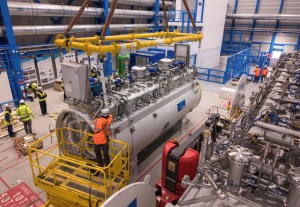
Startup TAU systems has built a commercial laser-powered particle accelerator that fits in a single room. Credit: TAU Systems

Room-Size Particle Accelerators Go Commercial

By Charles Q. Choi Particle accelerators are usually huge structures—think of the 3.2-kilometer–long SLAC National Accelerator Laboratory in Stanford, Calif. But scientists have been hard at work trying to shrink these accelerators down by using lasers to perform the accelerating. These particle accelerators would be the size of single room, and cost much less as well. Now, a startup says...

ADVERTISEMENT

Dewar

A dewar is a type of cryostat named after Sir James Dewar, the researcher who first developed the concept of a vacuum insulated container with silvered walls to reflect thermal radiation. Dewar was the first to liquefy hydrogen, and he created the device to store his discovery. The thermos bottle...

Stirling and Gifford-McMahon Cryocoolers

Stirling and Gifford-McMahon (GM) cryocoolers are two of the most commonly used cryocoolers in cryogenics. Both devices have a significant industrial base and operate at a wide range of temperatures and capacities. The thermodynamic cycles for both of these cryocoolers are quite similar. The Stirling cycle consists of a compressor,...

Liquefied Natural Gas (LNG)

A significant commercial application of cryogenics is the liquefaction, transport and storage of natural gas. Liquefied Natural Gas (LNG) is generally 95 percent methane with a few percent ethane and much lower concentrations of propane and butane. LNG liquefies at 111.6 K. Unlike many applications of cryogenics, the motivation for...

Wind Tunnels

Dr. Robert Kilgore The development of the cryogenic wind tunnel is one of many significant breakthroughs in both cryogenics and wind-tunnel technology made during the past millennium. Interest in the development of high-speed commercial and military aircraft resulted in a review of problems of flow simulation in transonic wind tunnels...

History of Cryogenics

From the Fall 1999 issue of Cold Facts magazine Millennium Breakthroughs A variety of CSA members give different perspectives on the past millennium: What were the most significant breakthroughs in cryogenics during the past millennium? Prof. R.G. Scurlock, Kryos Technology, scurlock@soton.ac.uk (“Breakthrough” = way through obstacles — Oxford English Dictionary)...

Cryobiology

Andreas Sputtek Past President Society for Cryobiology sputtek@uke.uni-hamburg.de or http://www.sputtek.de/. The word cryobiology (from the Greek words “cryo” = cold, “bios” = life, and “logos” = science) literally signifies the science of life at low temperatures. In practice, this field comprises the study of any biological material or system (e.g.,...

Cryogenic Insulation

James E. Fesmire Cryogenics Test Laboratory NASA Kennedy Space Center james.e.fesmire@nasa.gov Introduction In today’s world, the use of cryogenics and low-temperature refrigeration is taking a more and more significant role. From the food industry, transportation, energy, and medical applications to the Space Shuttle, cryogenic liquids must be stored, handled, and...

Getter materials to absorb out gassed materials?

Here’s one for the scientists: We would like to sell vacuum insulated pipe for high temperature fluid applications. Are there any good getter materials that we can place in the vacuum space of our VJP to absorb outgassed materials at elevated temperatures?