ADVERTISEMENT

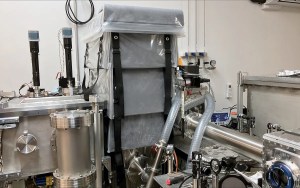
Professor Stefanie Gutschmidt, Head of UC’s Department of Mechanical Engineering, and UC Principal Researcher Dr Alan Caughley run the cyrocooler technology in the new CryoLab. Credit: UC Canterberry

UC Launches New Lab to Advance Cryogenics Research

University of Canterbury News The University of Canterbury (UC) has launched a new lab dedicated to cryogenics research and consultancy. CryoLab is now Aotearoa New Zealand’s only cryogenics research group combining advanced cryogenic refrigeration research with consulting to industry in cryogenics, fluid mechanics, and thermodynamics. Cryogenics is the science of...

Quantum Design Acquires Oxford NanoScience, Joining Two Historic Cryogenic Companies

Quantum Design Acquires Oxford NanoScience, Joining Two Historic Cryogenic Companies

Quantum Design (QD) is pleased to announce the completion of the acquisition of the Oxford NanoScience division of Oxford Instruments. This acquisition unites two industry leaders with a combined legacy of more than 100 years of experience and innovation in cryogenics, materials science, and microscopy. The expanded, shared product catalog...
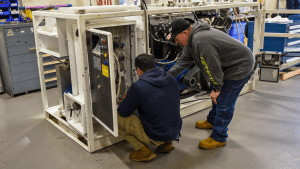
Working with substances at temperatures below negative 200 degrees the cryogenics team at NAWCAD Lakehurst specializes in servicing oxygen and nitrogen systems on aircraft, focusing on the storage and dispersal of liquid and gaseous nitrogen and oxygen. Credit: US Navy

NAWCAD Lakehurst enhances Cryogenic Systems for Naval Aviation

As the Cryogenics and Corrosion Control Support Equipment (SE) Integrated Product Team (IPT) Lead at NAWCAD Lakehurst, Asif Yeahia knows that many people may not fully understand the work his team does. However, working with substances at temperatures below negative 200 degrees gives them one of the “coolest” jobs at the...
Startup TAU systems has built a commercial laser-powered particle accelerator that fits in a single room. Credit: TAU Systems

Room-Size Particle Accelerators Go Commercial

By Charles Q. Choi Particle accelerators are usually huge structures—think of the 3.2-kilometer–long SLAC National Accelerator Laboratory in Stanford, Calif. But scientists have been hard at work trying to shrink these accelerators down by using lasers to perform the accelerating. These particle accelerators would be the size of single room, and cost much less as well. Now, a startup says...

Chinese Physicists Settle Einstein and Bohr’s Quantum Debate

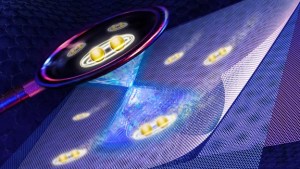
A groundbreaking experiment recreates Einstein’s 1927 thought challenge, confirming fundamental quantum principle. In a landmark study that brings a definitive close to one of the most famous debates in modern physics, a team of Chinese scientists has experimentally validated Niels Bohr’s core quantum principle, demonstrating that a particle’s path and...

Twisted Stacks of 2-D Carbon Act Like a Weird Type of Superconductor

“Magic-angle” graphene could help solve the puzzle of how unconventional superconductors work By Emily Conover Stacks of graphene, carefully twisted, gain a superpower: They become superconductors. Now scientists have new evidence that this “magic-angle” graphene is a member of a truly strange class of superconductor. Like all superconductors, the materials, known...

ADVERTISEMENT

Dewar

A dewar is a type of cryostat named after Sir James Dewar, the researcher who first developed the concept of a vacuum insulated container with silvered walls to reflect thermal radiation. Dewar was the first to liquefy hydrogen, and he created the device to store his discovery. The thermos bottle...

Stirling and Gifford-McMahon Cryocoolers

Stirling and Gifford-McMahon (GM) cryocoolers are two of the most commonly used cryocoolers in cryogenics. Both devices have a significant industrial base and operate at a wide range of temperatures and capacities. The thermodynamic cycles for both of these cryocoolers are quite similar. The Stirling cycle consists of a compressor,...

Liquefied Natural Gas (LNG)

A significant commercial application of cryogenics is the liquefaction, transport and storage of natural gas. Liquefied Natural Gas (LNG) is generally 95 percent methane with a few percent ethane and much lower concentrations of propane and butane. LNG liquefies at 111.6 K. Unlike many applications of cryogenics, the motivation for...

Magnets

From “Superconductivity: Present and Future Applications” by the Coalition for the Commercial Application of Superconductors. Particle physics uses accelerators to recreate the conditions of the early universe in an attempt to piece together the complex puzzle of how we got to where we are today. These huge machines are used...

Energy Storage

From “Superconductivity: Present and Future Applications” by the Coalition for the Commercial Application of Superconductors. With power lines increasingly congested and prone to instability, strategic injection of brief bursts of real power can play a crucial role in maintaining grid reliability. Small-scale Superconducting Magnetic Energy Storage (SMES) systems, based on...

Astronomy

ASTRONOMY IN SPACE by Peter V. Mason, retired,  Jet Propulsion Laboratory, and Visiting Associate, California Institute of Technology. Pmason@alumni.caltech.edu In thinking about the reasons to perform astronomy in space, we first consider the effect of the earth’s atmosphere.  On a scale of decreasing energy, gamma rays, cosmic rays, X-rays and...

Cryocoolers

What is a Cryocooler? A mechanism that can extract heat from an object (cooler) and by doing so draw its temperature down below approximately 150 Kelvin (cryo). — (Courtesy Dr. Willy Gully) What is the difference between a Cryocooler and a Cryostat? A cryostat is any device designed to maintain...

Could an Amateur Construct a Liquid Air Plant?

I am a newly retired experimental physicist. Is it feasible for an “amateur” to construct a liquid air plant? Do you have detailed descriptions of older (presumably simpler) liquid air plants, or references that might be of assistance?