ADVERTISEMENT

In DNA–Scientists find solution to building superconductor that could transform technology

Scientists at the University of Virginia School of Medicine and their collaborators have used DNA to overcome a nearly insurmountable obstacle to engineer materials that would revolutionize electronics.  One possible outcome of such engineered materials could be superconductors, which have zero electrical resistance, allowing electrons to flow unimpeded. That means...
Researchers Take First-Ever Cryo-EM Images of Nitrogenase in Action

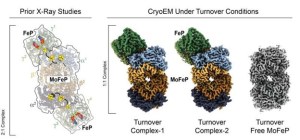
Previously, it has been impossible to capture the high-resolution images of nitrogenase, the only enzyme capable of reducing nitrogen into ammonia, during catalytic action. Now, for the first time, researchers at the University of California San Diego report near-atomic-resolution snapshots of nitrogenase during catalysis using cryogenic electron microscopy (cryoEM). The...

“Gas stations” in Zero Gravity

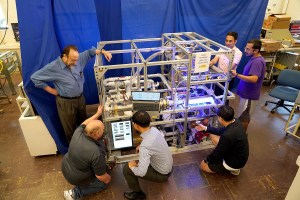
To journey and return from other planets, future spacecraft may have to do something they’ve never done before: refuel in space. Thanks to a Purdue University experiment, scientists are now beginning to understand how cryogenic liquids behave in zero-gravity, and how this affects the future operation of propellant depots in...

Space Cryogenics: The ECOSTRESS Instrument After Four Years in Space

The instrument is approaching four years of operation in space, with its over- all thermal performance as predicted and no changes to cryocooler performance. To date, all three cryocoolers have accumulated over 32,000 operating hours. On the 210th day after the initial power-on, a fault condition was detected, and the...

The Cold Facts of the Spitzer Space Telescope

NASA’s Spitzer Space Telescope, launched in August 2003 and decommissioned in January 2020 after more than 16 glorious years of exploration of the universe at infrared wavelengths, was a technical and scientific marvel. Infrared astronomical studies at wavelengths longward of 1 micron, somewhat beyond the limit of human vision at...

ADVERTISEMENT

Dewar

A dewar is a type of cryostat named after Sir James Dewar, the researcher who first developed the concept of a vacuum insulated container with silvered walls to reflect thermal radiation. Dewar was the first to liquefy hydrogen, and he created the device to store his discovery. The thermos bottle...

Stirling and Gifford-McMahon Cryocoolers

Stirling and Gifford-McMahon (GM) cryocoolers are two of the most commonly used cryocoolers in cryogenics. Both devices have a significant industrial base and operate at a wide range of temperatures and capacities. The thermodynamic cycles for both of these cryocoolers are quite similar. The Stirling cycle consists of a compressor,...

Liquefied Natural Gas (LNG)

A significant commercial application of cryogenics is the liquefaction, transport and storage of natural gas. Liquefied Natural Gas (LNG) is generally 95 percent methane with a few percent ethane and much lower concentrations of propane and butane. LNG liquefies at 111.6 K. Unlike many applications of cryogenics, the motivation for...

Cryogenic Electronics

Randall Kirschman, consulting physicist, Mountain View, California ExtElect@gmail.com Cryogenic electronics—the operation of electronic devices, circuits, and systems at cryogenic temperatures—has been a valuable technology for decades. Cryogenic electronics (also referred to as low-temperature electronics, or cold electronics) can be based on semiconductive devices, on superconductive devices, or on a combination...

Particle Physics: High Energy Physics

Cryogenics and High-Energy Physics 1. From symmetry magazine: http://www.symmetrymagazine.org/cms/?pid=1000627: Cryogenics is the study of how materials behave at temperatures near absolute zero. In high-energy particle accelerators, such frigid temperatures reduce the electrical resistance of wires in superconducting magnets, increasing the magnet strength and allowing faster particle acceleration. The same holds...

HTS Degaussing Systems

From the Spring 2009 issue of Cold Facts (Volume 25, Number 2): Thanks to a joint project by the US Navy and a number of industry partners, high temperature superconducting (HTS) technology is now at the heart of an advanced degaussing system aboard the USS Higgins at the naval station...

Magnetic Resonance Imaging

From http://www.superconductors.org: An area where superconductors can perform a life-saving function is in the field of biomagnetism. Doctors need a non-invasive means of determining what’s going on inside the human body. By impinging a strong superconductor-derived magnetic field into the body, hydrogen atoms that exist in the body’s water and...

Consultant knowledgeable in LNG

My company is seeking a consultant who is knowledgeable in LNG. It is a project located overseas, and involves a refinery and heat exchangers. Can anyone provide me with a reference?

Source for small gas liquefier/cryocooler?

I would like to acquire a used gas liquefier/cryocooler for use in my non-profit project to build a high-performance natural gas (methane) powered car. I am interested in liquefying piped natural gas (methane) into LNG (about 120K or -154 degrees).