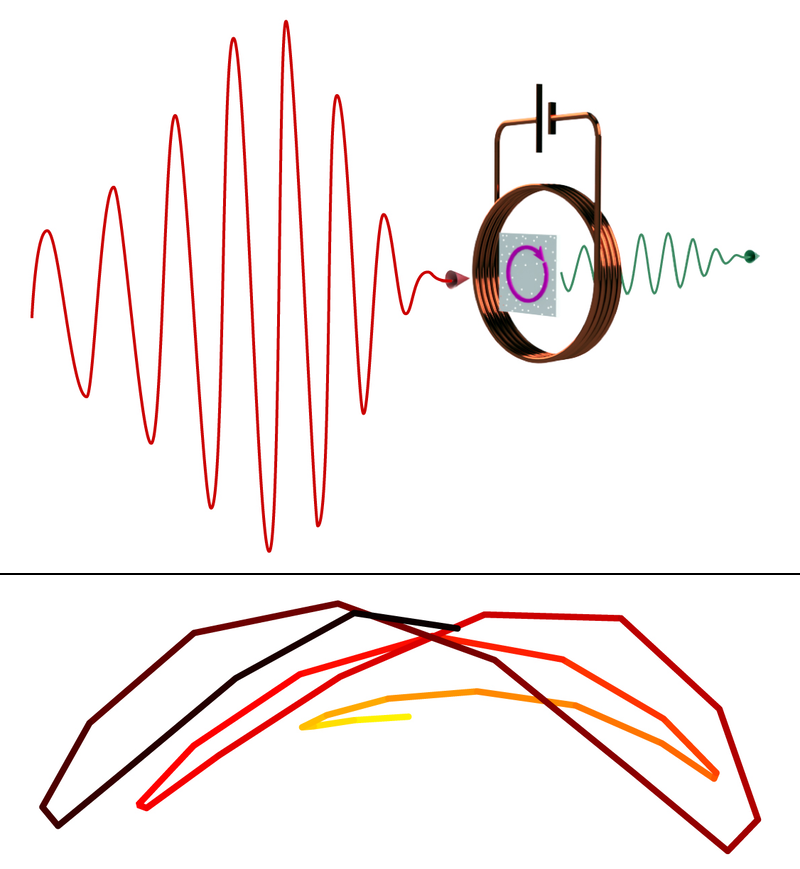
Peering into the vortex. Top: Vortices form in a superconducting film (gray) in the presence of an external magnetic field provided by a coil. The field generates a shielding current in the film (pink). An infrared pulse transmitted through the superconducting film provides information about the vortices’ velocities, masses, and positions. Bottom: Vortex trajectory during about 9 picoseconds of the infrared pulse. Color indicates time, running from yellow (earliest time) to black (latest time). The horizontal range of this trajectory is about 1 µm, whereas the vertical scale is stretched, and the range is only about 0.1 µm.
Nakamura and her colleagues have now developed their technique to measure vortex motion in two dimensions, this time in the iron-based superconductor FeSe0.5Te0.5, or FST. The researchers fabricated a 38-nm-thick film of FST and cooled it below its superconducting transition temperature (16.5 K). A coil generated a magnetic field, which produced vortices in the film. Additionally, the magnetic field induced a shielding current, which traced out a several-millimeter-diameter circle on the film.
The researchers irradiated the film with a 20-picosecond infrared (0.3-terahertz) pulse and detected a second harmonic in the spectrum of the pulse that emerged from the sample, as in the previous experiments. But here they detected both polarizations of the emitted light, parallel and perpendicular to the incident pulse’s polarization.
Using a roughly 1-mm-wide beam, they probed a region near the ring of the field-induced shielding current and then analyzed the transmitted waveforms in order to reconstruct the motion of a typical vortex residing in that location. The team found an oscillating, roughly parabolic trajectory rather than a straight line. This shape resulted from the interaction between the vortex, which is magnetic, and the shielding current. Discovering this motion was the most exciting part of the work, Nakamura says. “It felt like we were looking directly into the 2D motion of the vortex.”
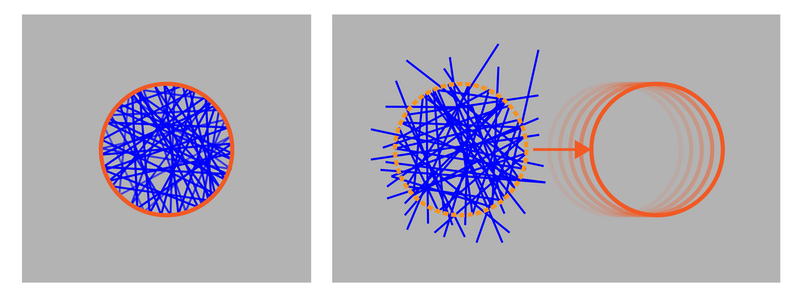
Missing something? A vortex (orange) moving in a superconducting film leaves behind most of the free electrons (blue) originally contained in its core, rendering it 10,000 times lighter than expected.
The data suggest that the vortices moved at speeds as high as 300 km/s, much faster than was predicted. Itsuhiro Kakeya, who studies terahertz technology at Kyoto University, Japan, says that the effective vortex mass, measured from its inertia, was far from expectations. “The mass of a vortex has been thought to be equivalent to 10,000 free electrons, but these results show that it is of the same order as a [single] free electron, which is a surprising claim,” he says. The finding supports a picture in which a rapidly oscillating vortex leaves behind many of the nonsuperconducting electrons originally trapped inside it. Nakamura points out that this scenario implies that vortex theories should treat vortex motion independently from that of the associated nonsuperconducting electrons.
According to Kakeya, visualizing the motion of superconducting vortices on the picosecond timescale is a very important achievement. Zhe Wang, who studies correlated quantum materials at the Technical University of Dortmund, Germany agrees. “Terahertz second-harmonic generation is not very often reported in the literature,” he says. The new study not only reports this phenomenon in a new class of superconductor but also uses it to examine vortex dynamics and properties. “Since other experimental methods have observed unique properties of this material, we expect that their relationship to this small vortex mass will be elucidated,” says Kakeya.
Lead Image: Caught in the whirlpool. Many superconductors form vortices of electric current (suggested by this image of water) when they experience a strong enough magnetic field or when they carry a steady current that is large enough. Understanding and controlling the motion of these objects is key to increasing current flow in superconducting devices. Credit:kichigin19/stock.adobe.com
Source: physics.aps.org
References
- S. Nakamura et al., “Picosecond trajectory of two-dimensional vortex motion in FeSe0.5Te0.5 visualized by terahertz second harmonic generation,” Phys. Rev. Lett. 133, 036004 (2024).
- S. Nakamura et al., “Nonreciprocal terahertz second-harmonic generation in superconducting NbN under supercurrent injection,” Phys. Rev. Lett. 125, 097004 (2020).