ADVERTISEMENT

Biomedical News Scientists Shine a Laser Through a Human Head It’s the first step toward an inexpensive new medical imager

Scientists Shine a Laser Through a Human Head

The possible path of 50 photons sent through a human head from a laser [left, in red] to a detector [right, green]. Credit:  Extreme Light group/University of Glasgow    For the most part, anyone who wants to see what’s going on inside someone else’s brain has to make a trade-off when...
The National Radio Astronomy Observatory (NRAO) and Associated Universities, Inc. (AUI) are launching a two-year initiative to design a next-generation radio telescope with capabilities far beyond existing observatories. Building on the success of the NSF’s Karl G. Jansky Very Large Array (VLA), the proposed array—called the next-generation Very Large Array (ngVLA)—will feature over 200 antennas spanning the US desert southwest and northern Mexico. This facility aims to advance our understanding of planets, galaxies, black holes, and fundamental physics. Credit: Bill Saxton, NRAO/AUI/NSF

NSF National Radio Astronomy Observatory and RIX Industries Join Forces to Revolutionize Cryogenic Cooling for the ngVLA Project

by RIX Industries Communications Team In a groundbreaking collaboration that could change the landscape of both scientific discovery and cryogenic technology, the U.S. National Science Foundation’s National Radio Astronomy Observatory (NSF NRAO) has teamed up with RIX Industries to develop cutting-edge cryogenic cooling solutions for the Next Generation Very Large...
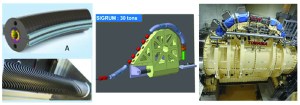
A high precision accelerator cryomodule produced by Meyer Tool for use in a particle accelerator at Brookhaven National Lab. MTM’s fabrication expertise is trusted by national labs and quantum technology firms worldwide. Credit: Meyer Tool & Manufacturing, Inc.

Meyer Tool Builds the Impossible, Empowering Illinois Manufacturing

by Christian Cunningham, Meyer Tool & Manufacturing Inc. Meyer Tool & Manufacturing, Inc., a long-standing leader in cryogenic, pressure and vacuum technologies, has reached a major milestone in its growth journey. The Illinois Department of Commerce and Economic Opportunity (DCEO) recently approved the company for participation in the Manufacturing Illinois...
Figure 1: An artist's rendering of the COSI satellite. Credit: Northrop Grumman Systems Corporation

Goddard Goings

An insight into past, present and future cryogenic missions where the Cryogenics and Fluids Branch at NASA Goddard Space Flight Center had or has a significant role. by Mark Kimball, Ph.D., Cryogenics and Fluids Branch, NASA Goddard Space Flight Center Readers of this column may recall last year’s recounting of...

ADVERTISEMENT

Dewar

A dewar is a type of cryostat named after Sir James Dewar, the researcher who first developed the concept of a vacuum insulated container with silvered walls to reflect thermal radiation. Dewar was the first to liquefy hydrogen, and he created the device to store his discovery. The thermos bottle...

Stirling and Gifford-McMahon Cryocoolers

Stirling and Gifford-McMahon (GM) cryocoolers are two of the most commonly used cryocoolers in cryogenics. Both devices have a significant industrial base and operate at a wide range of temperatures and capacities. The thermodynamic cycles for both of these cryocoolers are quite similar. The Stirling cycle consists of a compressor,...

Liquefied Natural Gas (LNG)

A significant commercial application of cryogenics is the liquefaction, transport and storage of natural gas. Liquefied Natural Gas (LNG) is generally 95 percent methane with a few percent ethane and much lower concentrations of propane and butane. LNG liquefies at 111.6 K. Unlike many applications of cryogenics, the motivation for...

Cryogenic Electronics

Randall Kirschman, consulting physicist, Mountain View, California ExtElect@gmail.com Cryogenic electronics—the operation of electronic devices, circuits, and systems at cryogenic temperatures—has been a valuable technology for decades. Cryogenic electronics (also referred to as low-temperature electronics, or cold electronics) can be based on semiconductive devices, on superconductive devices, or on a combination...

Particle Physics: High Energy Physics

Cryogenics and High-Energy Physics 1. From symmetry magazine: http://www.symmetrymagazine.org/cms/?pid=1000627: Cryogenics is the study of how materials behave at temperatures near absolute zero. In high-energy particle accelerators, such frigid temperatures reduce the electrical resistance of wires in superconducting magnets, increasing the magnet strength and allowing faster particle acceleration. The same holds...

HTS Degaussing Systems

From the Spring 2009 issue of Cold Facts (Volume 25, Number 2): Thanks to a joint project by the US Navy and a number of industry partners, high temperature superconducting (HTS) technology is now at the heart of an advanced degaussing system aboard the USS Higgins at the naval station...

Magnetic Resonance Imaging

From http://www.superconductors.org: An area where superconductors can perform a life-saving function is in the field of biomagnetism. Doctors need a non-invasive means of determining what’s going on inside the human body. By impinging a strong superconductor-derived magnetic field into the body, hydrogen atoms that exist in the body’s water and...

What is the temperature range of cryogenics?

Could you please tell me what is the temperature range of cryogenics? In other words, is -100°F considered cryogenic, or does it start lower? Could I expect to see some extended life in D2 stamping dies? What would the recipe be to achieve the desired results using cryogenics?