ADVERTISEMENT

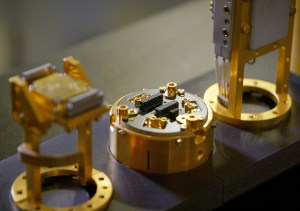
Images--Left: Current input terminal (100A compatible, size: outermost metal diameter Φ16mm x length 94mm) Right: MS-8 pin terminal (Maximum 110A, size: metal outer diameter Φ41mm x length 72.5mm)

World-First High-Current Terminals for Liquid Hydrogen

Kyocera Corporation (President and CEO: Hideo Tanimoto, hereinafter referred to as “Kyocera”) is pleased to announce that, through joint research with the Japan Aerospace Exploration Agency (hereinafter referred to as “JAXA”), it has developed two new products: a 100A current feedthrough terminal that ensures durability and airtightness in liquid hydrogen...

Making a Splash on Cryogenic Surfaces

Cryogenic surfaces do not hinder droplet splashing, but smaller droplets make smaller splashes. Hannah Richter On a rainy day, a classic physical property is on display: droplet splashing. How liquids splash is not just important for keeping one’s clothes dry, but for applications from inkjet printing to spraying crops to...

CERN Showcases Projects With Environmental Applications

CERN researchers are contributing to a growing number of projects aimed at developing technological solutions to environmental challenges—from fusion power and marine pollution detection to renewable energy distribution and cleaner aviation. These initiatives, carried out with academic and industrial partners, are coordinated through the CERN Innovation Programme for Environmental Applications...

New Evidence Sheds Light on Mystery of Magic-Angle Graphene’s Superconductivity

By Victoria Corless Scientists studying “magic-angle” graphene have captured the clearest evidence yet of the electronic signature behind its superconductivity, cutting through years of speculation about what drives its exotic behavior. “When superconductivity was first discovered in magic-angle graphene, it was surprising,” says Jeong Min Park of Princeton University. “Graphene...

New Near-Zero-Temperature Atomic Clock Aims to Redefine How Precisely We Measure Time

ByNeetika Walter Scientists in Toronto have unveiled a chilling breakthrough: a laser-regulated atomic clock cooled to just five degrees above absolute zero, promising a leap in timekeeping accuracy unlike anything used today. Physicists at the University of Toronto have developed the world’s first cryogenic single-ion optical atomic clock, a next-generation...

attocube and Quandela Deliver Lucy: World’s Most AdvancedPhotonic Quantum Computer

The French-German consortium Quandela and attocube systems GmbH has successfully delivered Lucy, a 12-qubit photonic quantum computer, to the Très Grand Centre de Calcul (TGCC) at CEA in France. Procured by the EuroHPC Joint Undertaking under the EuroQCS-France initiative, Lucy marks a major milestone in Europe’s quantum computing roadmap. Lucy...

ADVERTISEMENT

Dewar

A dewar is a type of cryostat named after Sir James Dewar, the researcher who first developed the concept of a vacuum insulated container with silvered walls to reflect thermal radiation. Dewar was the first to liquefy hydrogen, and he created the device to store his discovery. The thermos bottle...

Stirling and Gifford-McMahon Cryocoolers

Stirling and Gifford-McMahon (GM) cryocoolers are two of the most commonly used cryocoolers in cryogenics. Both devices have a significant industrial base and operate at a wide range of temperatures and capacities. The thermodynamic cycles for both of these cryocoolers are quite similar. The Stirling cycle consists of a compressor,...

Liquefied Natural Gas (LNG)

A significant commercial application of cryogenics is the liquefaction, transport and storage of natural gas. Liquefied Natural Gas (LNG) is generally 95 percent methane with a few percent ethane and much lower concentrations of propane and butane. LNG liquefies at 111.6 K. Unlike many applications of cryogenics, the motivation for...

Cryogenic Electronics

Randall Kirschman, consulting physicist, Mountain View, California ExtElect@gmail.com Cryogenic electronics—the operation of electronic devices, circuits, and systems at cryogenic temperatures—has been a valuable technology for decades. Cryogenic electronics (also referred to as low-temperature electronics, or cold electronics) can be based on semiconductive devices, on superconductive devices, or on a combination...

Particle Physics: High Energy Physics

Cryogenics and High-Energy Physics 1. From symmetry magazine: http://www.symmetrymagazine.org/cms/?pid=1000627: Cryogenics is the study of how materials behave at temperatures near absolute zero. In high-energy particle accelerators, such frigid temperatures reduce the electrical resistance of wires in superconducting magnets, increasing the magnet strength and allowing faster particle acceleration. The same holds...

HTS Degaussing Systems

From the Spring 2009 issue of Cold Facts (Volume 25, Number 2): Thanks to a joint project by the US Navy and a number of industry partners, high temperature superconducting (HTS) technology is now at the heart of an advanced degaussing system aboard the USS Higgins at the naval station...

Magnetic Resonance Imaging

From http://www.superconductors.org: An area where superconductors can perform a life-saving function is in the field of biomagnetism. Doctors need a non-invasive means of determining what’s going on inside the human body. By impinging a strong superconductor-derived magnetic field into the body, hydrogen atoms that exist in the body’s water and...