ADVERTISEMENT

Nitrofreeze Cryogenic Solutions Dry Ice Blasts for Historic Restorations

By Ryan Taylor, Nitrofreeze Cryogenic Solutions Dry ice blasting is used in a wide range of historic restoration projects, including a recent one completed in Rockport, Mass., in July of this year. Nitrofreeze Cryogenic Solutions was contracted to dry ice blast barn board wood inside a fishing hut to lighten...

Excel Loading Systems Innovates Cryogenic Fluid Transfer

by Excel Loading Systems Communications Since its establishment in 2013, Excel Loading Systems has rapidly emerged as a leading manufacturer of advanced loading arm systems, particularly excelling in cryogenic applications. Specializing in the safe and efficient transfer of liquefied gases such as LNG, liquid nitrogen, liquid oxygen and hydrogen, Excel...

Beyond Gravity Powers Europe’s New Weather Satellites with Advanced Technology

by Christian Thalmayr, Senior Manager Global Communication, Beyond Gravity In mid-August, the first in a new generation of European polar-orbiting weather satellites will launch aboard an Ariane 6 rocket from the European Spaceport in Kourou, South America. The MetOp-Second Generation (MetOp-SG) satellite will gather vital data on humidity, temperature and...
Kyle Appel, shown here standing in front of a liquid hydrogen storage tank, helped to develop a mathematical model and recommendations to improve liquid hydrogen storage tank operations. (Photo by Matthew Shenton/WSU)

Study Points Way to More Efficient Liquid Hydrogen Tanks

by Tina Hilding, Voiland College of Engineering and Architecture, Washington State University Washington State University researchers have developed a mathematical model and a set of recommendations to improve liquid hydrogen storage tank operations that could someday make hydrogen a more viable alternative for powering vehicles and other industrial processes. The...

ADVERTISEMENT

Dewar

A dewar is a type of cryostat named after Sir James Dewar, the researcher who first developed the concept of a vacuum insulated container with silvered walls to reflect thermal radiation. Dewar was the first to liquefy hydrogen, and he created the device to store his discovery. The thermos bottle...

Stirling and Gifford-McMahon Cryocoolers

Stirling and Gifford-McMahon (GM) cryocoolers are two of the most commonly used cryocoolers in cryogenics. Both devices have a significant industrial base and operate at a wide range of temperatures and capacities. The thermodynamic cycles for both of these cryocoolers are quite similar. The Stirling cycle consists of a compressor,...

Liquefied Natural Gas (LNG)

A significant commercial application of cryogenics is the liquefaction, transport and storage of natural gas. Liquefied Natural Gas (LNG) is generally 95 percent methane with a few percent ethane and much lower concentrations of propane and butane. LNG liquefies at 111.6 K. Unlike many applications of cryogenics, the motivation for...

Food Processing

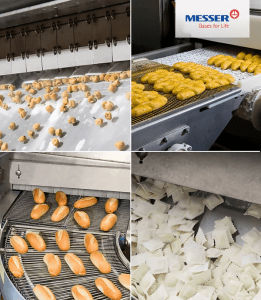
Cryogenics and Food The industrial gas industry provides a host of products and services related to food. The various gases have useful and sometimes fascinating applications in food industry. “The food industry is not a homogenous industry. The needs of customers processing hamburger vs. poultry vs. strawberries vs. seafood, for...

Primary Standards

Elie K. Track Hypres, Inc. elie@hypres.com http://www.hypres.com/ Primary standards involve the exact definition and realization of units of measurement for various quantities, time, length, mass, voltage, resistance, current, etc. International agreements based on the latest scientific knowledge define those units, and their realizations vary depending on the unit itself. For...

Shrink Fitting

Robin A. Rhodes Cryogenic Institute of New England, Inc. rrhodes@nitrofreeze.com Shrink fitting, (or “compression fitting” as it is sometimes called), is a method used to insert a pin or bushing into a housing or other assembly requiring an extremely tight tolerance fit. It can be used as an alternative to...

Telecommunications

From the Winter 2004 issue of Cold Facts magazine The recent M-Calc IV — 4th Industry Assessment workshop discussing military and commercial applications for low-cost cryocoolers, held in November in San Diego, highlighted progress being made in cryogenics as applied in telecommunications. The reliability and long lifetime of projects now...

Need help comparing chest freezers and upright freezers

Currently we use in our Biobank an upright -80 freezer to store all our samples. We are planning to buy a fully automated bio-repository storage that will do the picking of samples under restricted conditions. But in the meantime I foresee that we have to pick the samples manually. The...

Need recommendations for cryogenic vials

I am looking into standardizing our range of bio storage tubes (cryogenic vials). These will be for both blood and tissue samples and their derivatives. Any recommendations, comments on Micronics, Nalgene, Nunc and or others that are suitable for long term -80 C and -196 C storage, DNA/RNA suitable, would...

We need a custom machine for flash freezing of water

We are an ice making company and have started a new project, which is related to flash freezing of water. It is based on cryogenics technology and we need a custom made machine. I would kindly ask you to pass me a few companies who would be interested in such...

Looking for a pump suitable for cold liquids

I would like to construct a small cooling circuit (appr. 50 x 50 cm) pumping liquid at a temperature down to -120°C from a cold reservoir to the specimen to be cooled. The tubes and connections are not a problem, but does somebody know a pump (suction/compression for circulation) suitable...