ADVERTISEMENT

USC’s New Cryogenic Electron Microscopy Facility Officially Opens for Business

USC’s new cryogenic electron microscopy (cryo-EM) facility, featuring state-of-the-art instrumentation capable of imaging molecules, garnered the spotlight during a recent symposium celebrating the facility’s official grand opening. Scientists and officials from USC, biotechnology giant Amgen, Thermo Fisher Scientific, and noted academic research institutions gathered for the event, held in March at...

Ultra-lightweight Cryogenic Tank Aids Aircraft Industry Endeavors

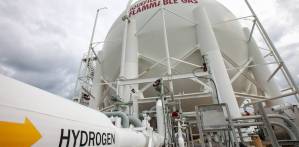
California-based firm HyPoint is developing an innovative cryogenic tank design that could massively boost the range of hydrogen-powered aircraft, a press statement reveals. HyPoint’s technology is extremely lightweight compared with traditional fuel cells and it could allow airliners to fly up to four times farther than traditional passenger aircraft. A 50-56 passenger...

Elusive superconducting-transition signature seen for the first time

Researchers in the US report that they have observed the so-called “fourth signature” of superconducting phase transitions in materials known as cuprates. The result, obtained via photoemission spectroscopy of a cuprate called Bi2212, could shed fresh light on how these materials, which conduct electricity without resistance at temperatures of 77...

Webb Telescope’s Coldest Instrument Reaches Operating Temperature

NASA’s James Webb Space Telescope will see the first galaxies to form after the big bang, but to do that its instruments first need to get cold – really cold. On April 7, Webb’s Mid-Infrared Instrument (MIRI) – a joint development by NASA and ESA (European Space Agency) – reached its...

Multiphoton Generator on a Chip

Producing entangled photons whose properties are interdependent is key to several quantum communication technologies. Most techniques for generating these photons make them exclusively in pairs, and those that can produce more than two photons are difficult to implement. But researchers have now made a chip-sized device that can generate bunches...

ADVERTISEMENT

Dewar

A dewar is a type of cryostat named after Sir James Dewar, the researcher who first developed the concept of a vacuum insulated container with silvered walls to reflect thermal radiation. Dewar was the first to liquefy hydrogen, and he created the device to store his discovery. The thermos bottle...

Stirling and Gifford-McMahon Cryocoolers

Stirling and Gifford-McMahon (GM) cryocoolers are two of the most commonly used cryocoolers in cryogenics. Both devices have a significant industrial base and operate at a wide range of temperatures and capacities. The thermodynamic cycles for both of these cryocoolers are quite similar. The Stirling cycle consists of a compressor,...

Liquefied Natural Gas (LNG)

A significant commercial application of cryogenics is the liquefaction, transport and storage of natural gas. Liquefied Natural Gas (LNG) is generally 95 percent methane with a few percent ethane and much lower concentrations of propane and butane. LNG liquefies at 111.6 K. Unlike many applications of cryogenics, the motivation for...

Cryogenic Electronics

Randall Kirschman, consulting physicist, Mountain View, California ExtElect@gmail.com Cryogenic electronics—the operation of electronic devices, circuits, and systems at cryogenic temperatures—has been a valuable technology for decades. Cryogenic electronics (also referred to as low-temperature electronics, or cold electronics) can be based on semiconductive devices, on superconductive devices, or on a combination...

Particle Physics: High Energy Physics

Cryogenics and High-Energy Physics 1. From symmetry magazine: http://www.symmetrymagazine.org/cms/?pid=1000627: Cryogenics is the study of how materials behave at temperatures near absolute zero. In high-energy particle accelerators, such frigid temperatures reduce the electrical resistance of wires in superconducting magnets, increasing the magnet strength and allowing faster particle acceleration. The same holds...

HTS Degaussing Systems

From the Spring 2009 issue of Cold Facts (Volume 25, Number 2): Thanks to a joint project by the US Navy and a number of industry partners, high temperature superconducting (HTS) technology is now at the heart of an advanced degaussing system aboard the USS Higgins at the naval station...

Magnetic Resonance Imaging

From http://www.superconductors.org: An area where superconductors can perform a life-saving function is in the field of biomagnetism. Doctors need a non-invasive means of determining what’s going on inside the human body. By impinging a strong superconductor-derived magnetic field into the body, hydrogen atoms that exist in the body’s water and...