ADVERTISEMENT

zeroBOG™ Empowers Sustainable Operations

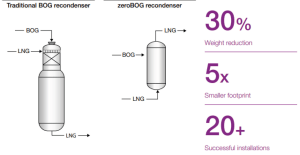
by Lennis Perez and Edward Tay, Sulzer The need for efficient and sustainable management of cryogenic gases extends far beyond traditional LNG applications. Enabling the recovery and reuse of boiloff gases, or BOG, across sectors such as hydrogen, e-methane and ammonia, supports the transition to low-carbon fuels and helps operators...


Liquid Air Comes of Age in Manchester

by Mark Vyvyan Robinson, Business Development Director, Highview Power As electricity systems integrate increasing volumes of renewable generation, the requirement for long-duration energy storage has become a defining challenge of the global energy transition. In northwest England, the city of Manchester and the surrounding Greater Manchester region are now home...

NASA Inches Closer to Martian Laser Communication

by Charlie Danaher, Danaher Cryogenics Bridging Interplanetary Distances Having a conversation between someone on Earth and Mars is not as science fiction as it used to be. That is thanks to scientists at NASA’s Jet Propulsion Laboratory (JPL) in Southern California and their successful demonstration of the Deep Space Optical...

Vacuum Chambers Answer Quantum Demands and UHV Transfer Needs

by Mel Janecka, Atlas Technologies Quantum computing companies and research facilities often find aluminum and titanium vacuum chambers to be better equipped to maintain purity and ultrahigh-vacuum (UHV) status. Plus, the chambers are non-magnetic and perform effectively within cryogenic conditions, critical for keeping qubits stable. Qubits, the basic units of...

Kathleen Amm’s Evolution in Cryo

When Kathleen Amm describes how she entered cryogenics, she does not point to a single defining moment. Instead, her path began with movement. In the early 1990s, she followed her thesis advisor Justin Schwartz from the University of Illinois to Tallahassee as the National High Magnetic Field Laboratory was opening....

WOMEN in CRYOGENICS and SUPERCONDUCTIVITY

Alexandria Burger, Bluefors – Manufacturing Engineer Manager Current projects: My current focus is leading a team to improve manufacturing efficiencies for 2026. These efficiency improvements will not only offset the increasing costs of materials but also allow us to reduce lead times. I also contribute to manufacturing documentation, 6S events,...

ADVERTISEMENT

Helium-3

Helium-3 (3He) is one of the two stable isotopes of helium. The other is the much more common Helium-4 (4He). Neither of these isotopes should be confused with He II, which is the second liquid phase of 4He. He II was discussed in this column in the Spring 2010 edition...

Cryopumping

Cryopumping refers to the use of cryogenic temperatures to produce vacuum in enclosed spaces. More broadly, it can also refer to the removal of gases via cryogenic temperatures from a flow stream or enclosure without necessarily resulting in vacuum pressures. This is an important application of cryogenics and is used...

Thermal Acoustic Oscillations

Thermal Acoustic Oscillations (TAO) are a common event in cryogenic systems that can have significant adverse effects on the performance of the system. TAOs are sustained pressure oscillations that can occur in tubes containing gas, closed at one end (the warm end) that have a very large temperature gradient along...

Food Processing

Cryogenics and Food The industrial gas industry provides a host of products and services related to food. The various gases have useful and sometimes fascinating applications in food industry. “The food industry is not a homogenous industry. The needs of customers processing hamburger vs. poultry vs. strawberries vs. seafood, for...

Primary Standards

Elie K. Track Hypres, Inc. elie@hypres.com http://www.hypres.com/ Primary standards involve the exact definition and realization of units of measurement for various quantities, time, length, mass, voltage, resistance, current, etc. International agreements based on the latest scientific knowledge define those units, and their realizations vary depending on the unit itself. For...

Shrink Fitting

Robin A. Rhodes Cryogenic Institute of New England, Inc. rrhodes@nitrofreeze.com Shrink fitting, (or “compression fitting” as it is sometimes called), is a method used to insert a pin or bushing into a housing or other assembly requiring an extremely tight tolerance fit. It can be used as an alternative to...

Telecommunications

From the Winter 2004 issue of Cold Facts magazine The recent M-Calc IV — 4th Industry Assessment workshop discussing military and commercial applications for low-cost cryocoolers, held in November in San Diego, highlighted progress being made in cryogenics as applied in telecommunications. The reliability and long lifetime of projects now...

Power usage: cryogenic systems vs. regular refrigerators

A recent project highlighted to me that closed cycle cryogenic cooling systems use far more electrical power to reduce temperatures by a few watts than regular refrigerators. I am sure it must be something to do with the extra difficulty of removing the heat from the liquid nitrogen or similar...

Redundancy strategies for mechanical -80C freezers

I was wondering what kind of redundancy strategies are people using for their mechanical -80C freezers? I am aware of the following. Please add if you are doing something different. 1) 1 Backup freezer for every 10 freezers – Empty and maintained at -80C at all times 2) Backup C02...

Method to move components in a cryogenic environment

Does anyone know of a method with which to reliably move components in a cryogenic environment? We are interested in moving detectors in a cryogenically cooled (2K) vacuum chamber, which is contained within a larger cryostat/isolation vacuum with thermal shields. As the desired horizontal or vertical displacement is between 10...