ADVERTISEMENT

Taking Charge: Predicting and Improving Energy Storage Materials

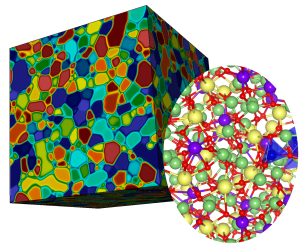
 Perfection is a problem when it comes to how computers model materials for energy applications. Although a typical model assumes materials are perfect, in reality they have flaws at their interfaces and boundaries. At Lawrence Livermore National Laboratory, researchers simulate ion transport for ways to predict and improve materials for energy...


QED-C® Announces Four Projects Designed to Advance Cryogenics for Quantum Information Science and Technology

The Quantum Economic Development Consortium (QED-C), managed by SRI International, in strategic partnership with the U.S. Department of Commerce’s National Institute of Standards and Technology (NIST), today announced a $2.3 million research program to advance cryogenic technologies that will enable innovation in quantum information science and technology (QIST). The program aims to...

Realizing the STEP Fusion Dream

Deliver a UK prototype fusion energy plant, targeting 2040, and thereafter a sustainable, long-term pathway to the commercial viability of nuclear fusion. That’s the ambitious objective – and even more ambitious timeline – confronting the scientists, engineers and project managers currently sweating the details for the conceptual design of the...

ADVERTISEMENT

Adiabatic Demagnetization Refrigeration

Reaching temperatures below 1K requires different techniques than the various helium gas cycles found in large scale refrigeration plants and small cryocoolers. One of these techniques is Adiabatic Demagnetization Refrigeration (ADR). This technique takes advantage of the fact that the entropy of paramagnetic materials in a magnetic field is lower than...

Cryogen-Free

A cryogen is any fluid that operates at cryogenic temperatures (below roughly 150K – 120K). Using this definition, helium gas at 40K is a cryogen. Another more restrictive definition is to use cryogen to refer specifically to liquids at cryogenic temperatures. This is generally how it is used in the...

Cryostats and Cryocoolers

A cryostat is any device designed to maintain things (including fluids) at cryogenic temperatures. In general usage, cryostats tend to be passive devices rather than providing active cooling. In this usage, cryostats keep things cold by thermally isolating them from room temperature. This generally is accomplished by a combination of...

Air Separation and Liquefaction

by Nils Tellier, PE, President, EPSIM Corporation (CSA CSM) nils@epsim.us All illustrations courtesy EPSIM Corporation Background History of Air Separation and Liquefaction This section builds on a rich history of methods to develop deep refrigeration and cryogenic liquefaction during the 19th Century. You are encouraged to read Cryo Central’s History...

Bose-Einstein Condensate

A Bose-Einstein condensate, first proposed in 1925 by Albert Einstein based on work done by Satyendra Nath Bose (the same Bose from whom the term boson is derived), is a super-cold state of matter in which almost all of the individual atoms have “condensed” down to the lowest possible quantum...

Cold Technology for Pest Control

While it does not reach temperatures cold enough to be called cryogenic, carbon dioxide snow is at the heart of a new way of dealing with unwanted pests. It utilizes a quick freezing process that takes advantage of the properties of carbon dioxide snow and has a number of benefits...

Cryogenic Finishing

The following 3 articles discuss the uses and procedures of various type of cryogenic finishing. 1) By Robin A. Rhodes, Cryogenic Institute of New England, Inc. rrhodes@nitrofreeze.com Cryogenic Deflashing is employed to remove undesired residual mold flash that remains on molded parts after they are removed or ejected from the...

Need help with calculating flow rate

I have to maintain a certain mass (some tons) at 100 K by circulating in it GHe (through apposite channels). How can I calculate the flow rate needed? I suppose that the delta T (T inlet and T outlet) and the heat load on the mass are necessary. Knowing the...