ADVERTISEMENT

NASA Inches Closer to Martian Laser Communication

by Charlie Danaher, Danaher Cryogenics Bridging Interplanetary Distances Having a conversation between someone on Earth and Mars is not as science fiction as it used to be. That is thanks to scientists at NASA’s Jet Propulsion Laboratory (JPL) in Southern California and their successful demonstration of the Deep Space Optical...

Vacuum Chambers Answer Quantum Demands and UHV Transfer Needs

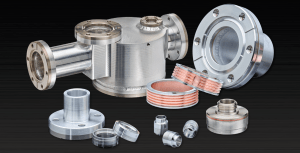
by Mel Janecka, Atlas Technologies Quantum computing companies and research facilities often find aluminum and titanium vacuum chambers to be better equipped to maintain purity and ultrahigh-vacuum (UHV) status. Plus, the chambers are non-magnetic and perform effectively within cryogenic conditions, critical for keeping qubits stable. Qubits, the basic units of...

Kathleen Amm’s Evolution in Cryo

When Kathleen Amm describes how she entered cryogenics, she does not point to a single defining moment. Instead, her path began with movement. In the early 1990s, she followed her thesis advisor Justin Schwartz from the University of Illinois to Tallahassee as the National High Magnetic Field Laboratory was opening....

WOMEN in CRYOGENICS and SUPERCONDUCTIVITY

Alexandria Burger, Bluefors – Manufacturing Engineer Manager Current projects: My current focus is leading a team to improve manufacturing efficiencies for 2026. These efficiency improvements will not only offset the increasing costs of materials but also allow us to reduce lead times. I also contribute to manufacturing documentation, 6S events,...

HiLumi LHC: cryogenics equipment arrives underground

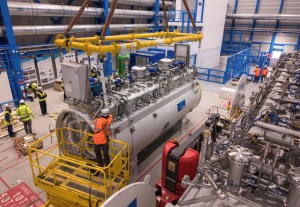
By Corinne Pralavorio The vertiginous descent of equipment into the depths of the accelerator tunnels is always a captivating event. The stars of the show over the last few weeks have been the two gleaming cold boxes that have arrived in the new service tunnels of the High-Luminosity LHC (HiLumi...

ADVERTISEMENT

Helium II

Helium II (He II) refers to the second liquid phase of the most abundant helium isotope (4He). Helium II is also referred to as superfluid helium. Helium II occurs once the temperature of the liquid helium drops below 2.17K. The phase transition between the first liquid phase of Helium (referred...

Air Separation and Liquefaction

by Nils Tellier, PE, President, EPSIM Corporation (CSA CSM) nils@epsim.us All illustrations courtesy EPSIM Corporation Background History of Air Separation and Liquefaction This section builds on a rich history of methods to develop deep refrigeration and cryogenic liquefaction during the 19th Century. You are encouraged to read Cryo Central’s History...

Bose-Einstein Condensate

A Bose-Einstein condensate, first proposed in 1925 by Albert Einstein based on work done by Satyendra Nath Bose (the same Bose from whom the term boson is derived), is a super-cold state of matter in which almost all of the individual atoms have “condensed” down to the lowest possible quantum...

Cold Technology for Pest Control

While it does not reach temperatures cold enough to be called cryogenic, carbon dioxide snow is at the heart of a new way of dealing with unwanted pests. It utilizes a quick freezing process that takes advantage of the properties of carbon dioxide snow and has a number of benefits...

Cryogenic Finishing

The following 3 articles discuss the uses and procedures of various type of cryogenic finishing. 1) By Robin A. Rhodes, Cryogenic Institute of New England, Inc. rrhodes@nitrofreeze.com Cryogenic Deflashing is employed to remove undesired residual mold flash that remains on molded parts after they are removed or ejected from the...

Suppliers of regenerator materials

I was looking for suppliers of regenerator materials. Can you please provide a list of vendors for: • Lead spheres • Bronze screen discs • Rare earth materials and spheres Thank you in advance for any help you can provide.

Containing ice accumulation while recovering helium

We are implementing a system to recover helium from our Janis ST-500 continuous flow LHe cryostat. The recovery system uses standard 1/4″ plastic tubing, which we connect directly to the cryostat’s exhaust port. The problem with this setup is that the gas is still quite cold as it leaves the...