ADVERTISEMENT

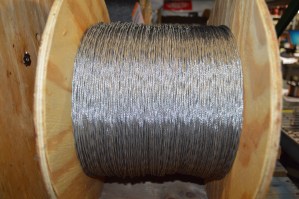
ALLVAR Alloy 30 expands when cooled, the opposite of invar and aluminum, and maintains negative thermal properties at cryogenic temperatures. Credit: Allvar

ALLVAR Alloys Solve Cryogenic Mismatch

ALLVAR Alloy 30 expands when cooled, the opposite of invar and aluminum, and maintains negative thermal properties at cryogenic temperatures. Credit: Allvar by James A. Monroe, Ph.D., ALLVAR Almost all materials expand when heated and contract when cooled, known as positive thermal expansion. Some materials expand and contract a lot...
Ice Cure medical Logo

IceCure Receives Notice of Patent Allowance in China for a Novel Cryogen Flow Control to Optimize Patient Cryoablation Outcomes

IceCure Medical Ltd., developer of minimally invasive cryoablation technology that destroys tumors by freezing them, announced that it has received a Notice of Allowance from the China National Intellectual Property Administration (CNIPA) for a new patent titled “Cryogen Flow Control.” The patent relates to IceCure’s next-generation XSense™ cryoablation system and...
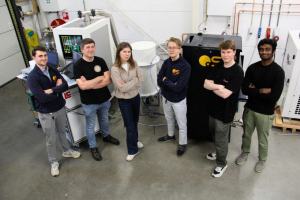
Professor Stefanie Gutschmidt, Head of UC’s Department of Mechanical Engineering, and UC Principal Researcher Dr Alan Caughley run the cyrocooler technology in the new CryoLab. Credit: UC Canterberry

UC Launches New Lab to Advance Cryogenics Research

University of Canterbury News The University of Canterbury (UC) has launched a new lab dedicated to cryogenics research and consultancy. CryoLab is now Aotearoa New Zealand’s only cryogenics research group combining advanced cryogenic refrigeration research with consulting to industry in cryogenics, fluid mechanics, and thermodynamics. Cryogenics is the science of...
Quantum Design Acquires Oxford NanoScience, Joining Two Historic Cryogenic Companies

Quantum Design Acquires Oxford NanoScience, Joining Two Historic Cryogenic Companies

Quantum Design (QD) is pleased to announce the completion of the acquisition of the Oxford NanoScience division of Oxford Instruments. This acquisition unites two industry leaders with a combined legacy of more than 100 years of experience and innovation in cryogenics, materials science, and microscopy. The expanded, shared product catalog...
Working with substances at temperatures below negative 200 degrees the cryogenics team at NAWCAD Lakehurst specializes in servicing oxygen and nitrogen systems on aircraft, focusing on the storage and dispersal of liquid and gaseous nitrogen and oxygen. Credit: US Navy

NAWCAD Lakehurst enhances Cryogenic Systems for Naval Aviation

As the Cryogenics and Corrosion Control Support Equipment (SE) Integrated Product Team (IPT) Lead at NAWCAD Lakehurst, Asif Yeahia knows that many people may not fully understand the work his team does. However, working with substances at temperatures below negative 200 degrees gives them one of the “coolest” jobs at the...
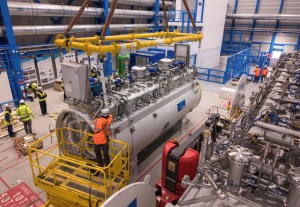
Startup TAU systems has built a commercial laser-powered particle accelerator that fits in a single room. Credit: TAU Systems

Room-Size Particle Accelerators Go Commercial

By Charles Q. Choi Particle accelerators are usually huge structures—think of the 3.2-kilometer–long SLAC National Accelerator Laboratory in Stanford, Calif. But scientists have been hard at work trying to shrink these accelerators down by using lasers to perform the accelerating. These particle accelerators would be the size of single room, and cost much less as well. Now, a startup says...

ADVERTISEMENT

Two-Phase Flows

Two-phase flows are those flows in which there is a mixture of two physical states (solid, liquid or vapor). In cryogenic applications, such flows are almost always a mixture of a cryogenic liquid along with its corresponding vapor. A mixture of liquid helium and helium vapor would be a typical...

Supercritical Fluids

A supercritical fluid is defined as a substance whose temperature and pressure exceed those of its critical point. Every pure substance has a critical point that is defined in thermodynamic space by a critical temperature and a corresponding critical pressure. For example, the critical point for helium has a critical...

Brayton Cycle

The Brayton cycle is one of the many thermodynamic cycles used to generate cooling at cryogenic temperatures. Strictly speaking, when referring to cooling we should call this the reverse Brayton cycle as the original Brayton cycle describes the process of power generation or propulsion via a gas turbine. In many...

Cryogenic Electronics

Randall Kirschman, consulting physicist, Mountain View, California ExtElect@gmail.com Cryogenic electronics—the operation of electronic devices, circuits, and systems at cryogenic temperatures—has been a valuable technology for decades. Cryogenic electronics (also referred to as low-temperature electronics, or cold electronics) can be based on semiconductive devices, on superconductive devices, or on a combination...

Particle Physics: High Energy Physics

Cryogenics and High-Energy Physics 1. From symmetry magazine: http://www.symmetrymagazine.org/cms/?pid=1000627: Cryogenics is the study of how materials behave at temperatures near absolute zero. In high-energy particle accelerators, such frigid temperatures reduce the electrical resistance of wires in superconducting magnets, increasing the magnet strength and allowing faster particle acceleration. The same holds...

HTS Degaussing Systems

From the Spring 2009 issue of Cold Facts (Volume 25, Number 2): Thanks to a joint project by the US Navy and a number of industry partners, high temperature superconducting (HTS) technology is now at the heart of an advanced degaussing system aboard the USS Higgins at the naval station...

Magnetic Resonance Imaging

From http://www.superconductors.org: An area where superconductors can perform a life-saving function is in the field of biomagnetism. Doctors need a non-invasive means of determining what’s going on inside the human body. By impinging a strong superconductor-derived magnetic field into the body, hydrogen atoms that exist in the body’s water and...

An Issue of Pressure and Flow Rate in a Supply Tank

Please help solve this problem: A supply tank requires a vaporizer to generate sufficient pressure to pump stored fluid up into a vehicle or tank. The available head is limited as the tank level falls and it is important to minimize the system pressure drop to maintain the desired flow...

Using MLI on VJ Line Joints or Cryo Storage Tanks

When installing Multi Layer Insulation (MLI) blankets on VJ line joints or cryo storage tanks should they be wrapped and tied down tight or loose? These are usually pre-cut to size. Also should they have an access hole at the point of where the molecular sieve is installed to help...