ADVERTISEMENT

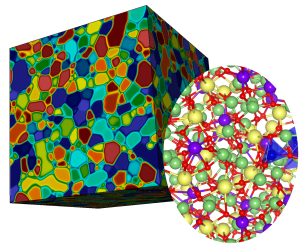
Taking Charge: Predicting and Improving Energy Storage Materials

 Perfection is a problem when it comes to how computers model materials for energy applications. Although a typical model assumes materials are perfect, in reality they have flaws at their interfaces and boundaries. At Lawrence Livermore National Laboratory, researchers simulate ion transport for ways to predict and improve materials for energy...


QED-C® Announces Four Projects Designed to Advance Cryogenics for Quantum Information Science and Technology

The Quantum Economic Development Consortium (QED-C), managed by SRI International, in strategic partnership with the U.S. Department of Commerce’s National Institute of Standards and Technology (NIST), today announced a $2.3 million research program to advance cryogenic technologies that will enable innovation in quantum information science and technology (QIST). The program aims to...

Realizing the STEP Fusion Dream

Deliver a UK prototype fusion energy plant, targeting 2040, and thereafter a sustainable, long-term pathway to the commercial viability of nuclear fusion. That’s the ambitious objective – and even more ambitious timeline – confronting the scientists, engineers and project managers currently sweating the details for the conceptual design of the...

ADVERTISEMENT

Adiabatic Demagnetization Refrigeration

Reaching temperatures below 1K requires different techniques than the various helium gas cycles found in large scale refrigeration plants and small cryocoolers. One of these techniques is Adiabatic Demagnetization Refrigeration (ADR). This technique takes advantage of the fact that the entropy of paramagnetic materials in a magnetic field is lower than...

Cryogen-Free

A cryogen is any fluid that operates at cryogenic temperatures (below roughly 150K – 120K). Using this definition, helium gas at 40K is a cryogen. Another more restrictive definition is to use cryogen to refer specifically to liquids at cryogenic temperatures. This is generally how it is used in the...

Cryostats and Cryocoolers

A cryostat is any device designed to maintain things (including fluids) at cryogenic temperatures. In general usage, cryostats tend to be passive devices rather than providing active cooling. In this usage, cryostats keep things cold by thermally isolating them from room temperature. This generally is accomplished by a combination of...

Cryogenic Electronics

Randall Kirschman, consulting physicist, Mountain View, California ExtElect@gmail.com Cryogenic electronics—the operation of electronic devices, circuits, and systems at cryogenic temperatures—has been a valuable technology for decades. Cryogenic electronics (also referred to as low-temperature electronics, or cold electronics) can be based on semiconductive devices, on superconductive devices, or on a combination...

Particle Physics: High Energy Physics

Cryogenics and High-Energy Physics 1. From symmetry magazine: http://www.symmetrymagazine.org/cms/?pid=1000627: Cryogenics is the study of how materials behave at temperatures near absolute zero. In high-energy particle accelerators, such frigid temperatures reduce the electrical resistance of wires in superconducting magnets, increasing the magnet strength and allowing faster particle acceleration. The same holds...

HTS Degaussing Systems

From the Spring 2009 issue of Cold Facts (Volume 25, Number 2): Thanks to a joint project by the US Navy and a number of industry partners, high temperature superconducting (HTS) technology is now at the heart of an advanced degaussing system aboard the USS Higgins at the naval station...

Magnetic Resonance Imaging

From http://www.superconductors.org: An area where superconductors can perform a life-saving function is in the field of biomagnetism. Doctors need a non-invasive means of determining what’s going on inside the human body. By impinging a strong superconductor-derived magnetic field into the body, hydrogen atoms that exist in the body’s water and...

An Issue of Pressure and Flow Rate in a Supply Tank

Please help solve this problem: A supply tank requires a vaporizer to generate sufficient pressure to pump stored fluid up into a vehicle or tank. The available head is limited as the tank level falls and it is important to minimize the system pressure drop to maintain the desired flow...

Using MLI on VJ Line Joints or Cryo Storage Tanks

When installing Multi Layer Insulation (MLI) blankets on VJ line joints or cryo storage tanks should they be wrapped and tied down tight or loose? These are usually pre-cut to size. Also should they have an access hole at the point of where the molecular sieve is installed to help...