ADVERTISEMENT

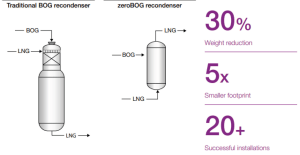
zeroBOG™ Empowers Sustainable Operations

by Lennis Perez and Edward Tay, Sulzer The need for efficient and sustainable management of cryogenic gases extends far beyond traditional LNG applications. Enabling the recovery and reuse of boiloff gases, or BOG, across sectors such as hydrogen, e-methane and ammonia, supports the transition to low-carbon fuels and helps operators...


Liquid Air Comes of Age in Manchester

by Mark Vyvyan Robinson, Business Development Director, Highview Power As electricity systems integrate increasing volumes of renewable generation, the requirement for long-duration energy storage has become a defining challenge of the global energy transition. In northwest England, the city of Manchester and the surrounding Greater Manchester region are now home...

NASA Inches Closer to Martian Laser Communication

by Charlie Danaher, Danaher Cryogenics Bridging Interplanetary Distances Having a conversation between someone on Earth and Mars is not as science fiction as it used to be. That is thanks to scientists at NASA’s Jet Propulsion Laboratory (JPL) in Southern California and their successful demonstration of the Deep Space Optical...

Vacuum Chambers Answer Quantum Demands and UHV Transfer Needs

by Mel Janecka, Atlas Technologies Quantum computing companies and research facilities often find aluminum and titanium vacuum chambers to be better equipped to maintain purity and ultrahigh-vacuum (UHV) status. Plus, the chambers are non-magnetic and perform effectively within cryogenic conditions, critical for keeping qubits stable. Qubits, the basic units of...

Kathleen Amm’s Evolution in Cryo

When Kathleen Amm describes how she entered cryogenics, she does not point to a single defining moment. Instead, her path began with movement. In the early 1990s, she followed her thesis advisor Justin Schwartz from the University of Illinois to Tallahassee as the National High Magnetic Field Laboratory was opening....

WOMEN in CRYOGENICS and SUPERCONDUCTIVITY

Alexandria Burger, Bluefors – Manufacturing Engineer Manager Current projects: My current focus is leading a team to improve manufacturing efficiencies for 2026. These efficiency improvements will not only offset the increasing costs of materials but also allow us to reduce lead times. I also contribute to manufacturing documentation, 6S events,...

ADVERTISEMENT

Regenerators

Regenerators or regenerative heat exchangers are a key component of cryocoolers such as pulse tube cryocoolers (Cold Facts, August 2014). Regenerator performance greatly affects the coefficient of performance of cryocoolers. Improvements in regenerator design and, in particular, regenerator materials have been an important factor in the improvement of the performance...

Pulse Tube Cryocoolers

The development of pulse tube cryocoolers has been a significant topic of research and development over the past 20 or so years. Pulse tube cryocoolers have a number of advantages over other types of cryocoolers and are now available commercially. In order to understand pulse tube cryocoolers, it’s best to...

Thermal Expansion

Thermal expansion refers to the change in size (length or volume) that a material undergoes as its temperature changes. In cryogenic systems this effect can be quite large and must be allowed for in the design. In isotropic materials, which include most engineering materials, the thermal expansion is the same...

Cryogenic Electronics

Randall Kirschman, consulting physicist, Mountain View, California ExtElect@gmail.com Cryogenic electronics—the operation of electronic devices, circuits, and systems at cryogenic temperatures—has been a valuable technology for decades. Cryogenic electronics (also referred to as low-temperature electronics, or cold electronics) can be based on semiconductive devices, on superconductive devices, or on a combination...

Particle Physics: High Energy Physics

Cryogenics and High-Energy Physics 1. From symmetry magazine: http://www.symmetrymagazine.org/cms/?pid=1000627: Cryogenics is the study of how materials behave at temperatures near absolute zero. In high-energy particle accelerators, such frigid temperatures reduce the electrical resistance of wires in superconducting magnets, increasing the magnet strength and allowing faster particle acceleration. The same holds...

HTS Degaussing Systems

From the Spring 2009 issue of Cold Facts (Volume 25, Number 2): Thanks to a joint project by the US Navy and a number of industry partners, high temperature superconducting (HTS) technology is now at the heart of an advanced degaussing system aboard the USS Higgins at the naval station...

Magnetic Resonance Imaging

From http://www.superconductors.org: An area where superconductors can perform a life-saving function is in the field of biomagnetism. Doctors need a non-invasive means of determining what’s going on inside the human body. By impinging a strong superconductor-derived magnetic field into the body, hydrogen atoms that exist in the body’s water and...

Thermal conductivity of niobium, tantalum, lead, tin

I am interested in the thermal conductivity and other properties of low temperature superconductors. Specifically I am interested in materials like Niobium, Tantalum, Lead and Tin. Would you know of a publication that dealt with thermal properties in general and also gave specific data on these materials?